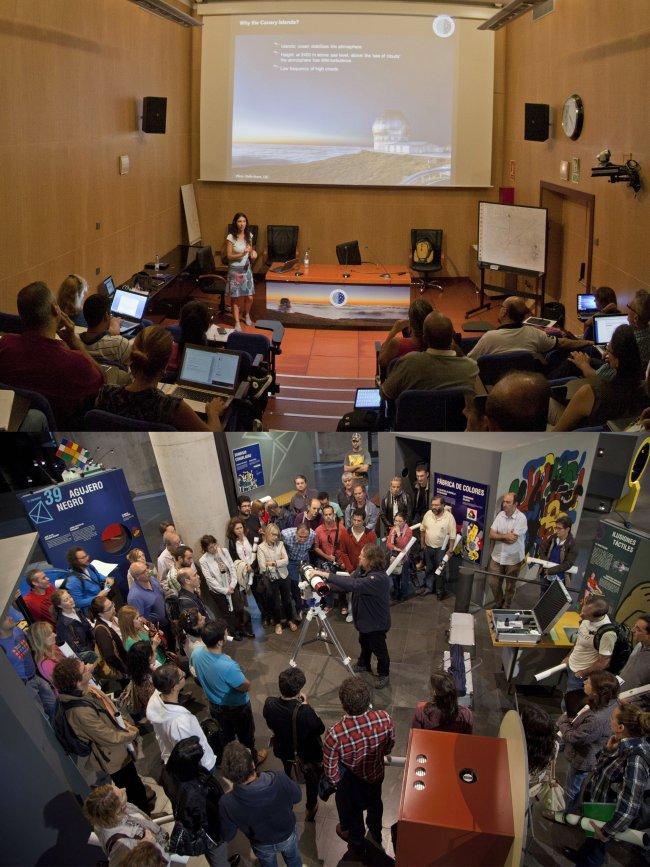
Los ponentes de las acciones formativas, Nayra Rodríguez Eugenio (arriba) y Alfred Rosenberg (abajo), durante charlas y talleres impartidos en cursos de formación de profesorado previos. Crédito: IAC.
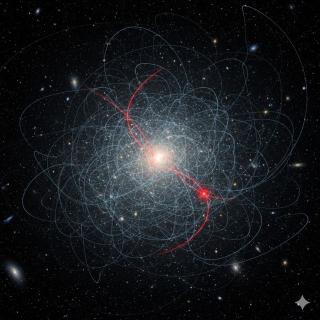
Ultra-faint dwarf galaxies, among the tiniest and faintest galaxies known, may hold the key to understanding one of the Universe’s biggest mysteries: the true nature of dark matter. A new study reveals that even a single collision between dark matter particles every 10 billion years — roughly the age of the Universe — is enough to explain the dark matter cores observed in these small systems. These galaxies, which contain only a few thousand stars, are dominated by dark matter and have relatively simple evolutionary histories. That makes them ideal cosmic laboratories for testing theories
The National Hub of Excellence in Quantum Communications held its general meeting on 10 and 11 February at the IACTEC building, located in the Tenerife Science and Technology Park. The event brought together representatives from Spain’s leading public institutions in the field of quantum technologies, consolidating the coordinated efforts undertaken within this strategic initiative. On Tuesday, 10 February, the programme addressed the Hub’s strategic vision within the national and European context, highlighting its alignment with Spain’s Quantum Technologies Strategy (2025–2030) and with
An international scientific team, including members of the Instituto de Astrofísica de Canarias (IAC), has launched an ambitious program to map exoplanets located around the Neptunian Desert —a region around stars where planets the size of Neptune are very rare— in order to better understand the mechanisms of planetary system evolution and formation. This scientific expedition has delivered its first results with the observation of the TOI-421 planetary system. Analysis of this system reveals a surprisingly inclined orbital architecture, offering new insights into the chaotic history of