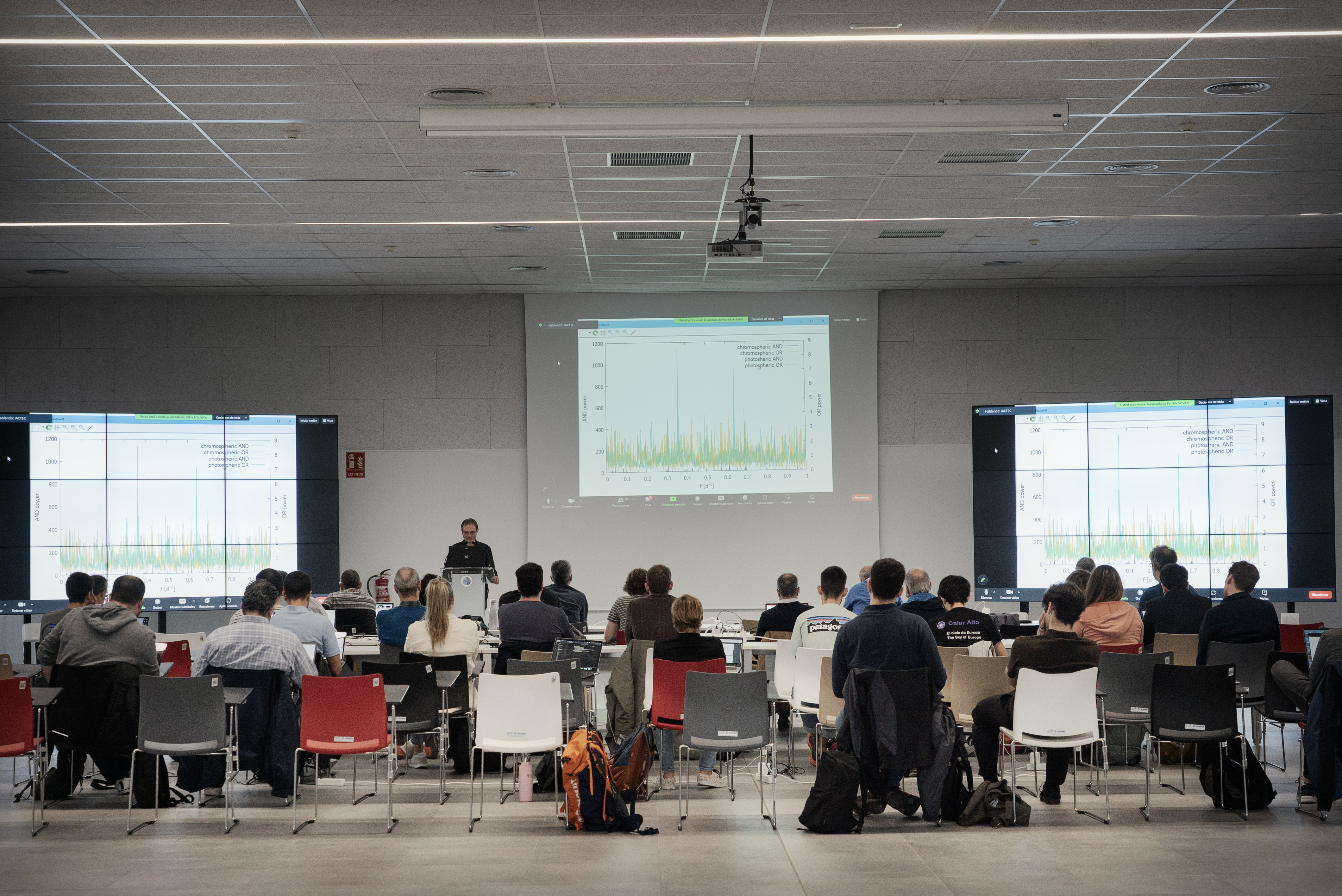
Participants at the CARMENES scientific meeting held at the IACTEC building in La Laguna (Tenerife, Spain). Credit: Inés Bonet (IAC)
Advertised on
The 19th scientific meeting of CARMENES, a collaboration of more than 100 scientists from 11 Spanish and German institutions aimed at studying extrasolar planets around M-type dwarf stars, the lowest mass stars, was held this week at the IACTEC facilities in La Laguna (Tenerife, Spain).
Since it became operational in 2016, CARMENES has analysed more than 360 such stars, leading to the discovery of more than 65 new planets, making it the most efficient instrument and mapper in the study of planets around very low-mass stars, with 30 % of the total number of planets discovered in this range.
The Instituto de Astrofísica Canarias (IAC) has been involved in the CARMENES instrument since its initial construction phases and IAC research staff have been part of the scientific coordination team and lead various working groups, such as those for photometric monitoring and candidate monitoring of the TESS satellite.
More than 50 scientists participated in this meeting, during which the latest actions aimed at improving the stability of the instrument and the latest scientific advances were shared, including the discovery of new rocky planets around M-type stars, multi-planetary systems, young planets and minineptunes suitable for the characterisation of their atmospheres. In addition to this research, studies are being carried out to characterise the activity of stars and to study the atmospheres of gaseous exoplanets.
CARMENES scientific meeting in the multi-purpose room of the IACTEC building. Credit: Inés Bonet (IAC)
Related projects
Exoplanets and Astrobiology
The search for life in the universe has been driven by recent discoveries of planets around other stars (known as exoplanets), becoming one of the most active fields in modern astrophysics. The growing number of new exoplanets discovered in recent years and the recent advance on the study of their atmospheres are not only providing new valuable
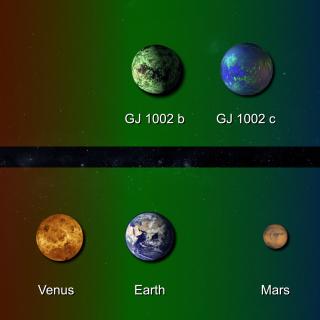
Red dwarfs are the most common stars in the galaxy. In recent years they have become key targets in the search for exoplanets. These stars are usually accompanied by rocky planets and due to their low brightness, their habitable zone is close to the star, making it easier to find planets that are within it. GJ 1002 is a red dwarf just one-eighth the mass of the Sun, located only 15.8 light-years away. Using radial velocity measurements from the ESPRESSO and CARMENES spectrographs, we have discovered the presence of two Earth-like and potentially habitable planets. The planets, GJ 1002 b and
20,000 observations from the Calar Alto telescope in Spain are made public, and have led to the discovery of 59 planets, some of them potentially habitable. The study, led by a consortium of Spanish and German institutions, has the prominent participation of the Instituto de Astrofísica de Canarias (IAC) and it is is published in the journal Astronomy & Astrophysics. The CARMENES project has just pub lished data from about 20,000 observations taken between 2016 and 2020 for a sample of 362 nearby cool stars. The project, which is financed with Spanish and German funds, uses the CARMENES
We report on the first star discovered to host a planet detected by radial velocity (RV) observations obtained within the CARMENES survey for exoplanets around M dwarfs. HD 147379 (V = 8.9 mag, M = 0.58 ± 0.08 M⊙), a bright M0.0 V star at a distance of 10.7 pc, is found to undergo periodic RV variations with a semi-amplitude of K = 5.1 ± 0.4 m s−1 and a period of P = 86.54 ± 0.06 d. The RV signal is found in our CARMENES data, which were taken between 2016 and 2017, and is supported by HIRES/Keck observations that were obtained since 2000. The RV variations are interpreted as resulting from
During October, the Adaptive Optics System team at the Gran Telescopio Canarias (GTCAO) of the Instituto de Astrofísica de Canarias (IAC), in collaboration with the technical team at the Gran Telescopio Canarias (GTC or Grantecan), successfully completed the integration of the GRANCAIN instrument into the world's largest optical-infrared telescope. The installation was carried out at the GTCAO outlet on the telescope's Nasmyth B platform, a key step in initiating performance testing of the new adaptive optics system. This is the first scientific instrument to operate using the GTC's adaptive
We present, for the first time, model spectra of single-age, single-metallicity stellar populations computed with the E-MILES evolutionary synthesis code incorporating an environment-dependent, variable galaxy-wide initial mass function (gwIMF). This gwIMF, calculated using the GalIMF code, is rooted in the integrated galactic initial mass function (IGIMF) theory, which predicts IMF variations as a function of the star formation rate and the metallicity. By coupling these two codes, we generated a comprehensive library of single-burst stellar population spectra uniquely sensitive to gwIMF
A multidisciplinary team of astrophysicists, neuroscientists, engineers, and musicians has unveiled a pioneering method to “listen” to the structure of the human brain. Published in Nature Scientific Reports , the study presents the first higher-order sonification applied to structural magnetic resonance imaging (MRI) data. This technique involves transforming three-dimensional information about the brain into sound, taking into account the spatial relationships and complex structure of the data. To do this, mathematical tools originally developed to study the large-scale structure of the