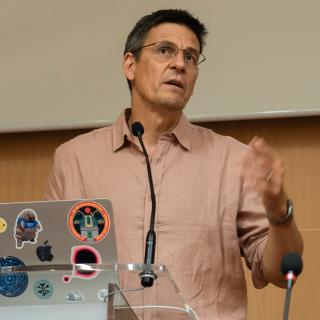
The Instituto de Astrofísica de Canarias (IAC) welcomed the visit of Professor Didier Queloz, Nobel Laureate in Physics and co-discoverer of the first exoplanet orbiting a Sun-like star. Professor Queloz's stay at the IAC has focused on instrumental development and technological collaboration. As part of his agenda, he also gave a lecture entitled ‘Exoplanets: the next frontier’ in the IAC Lecture Hall. The researcher visited the IAC to supervise the installation of a new high-stability spectrograph on the Isaac Newton Telescope (INT) at the Roque de los Muchachos Observatory on La Palma
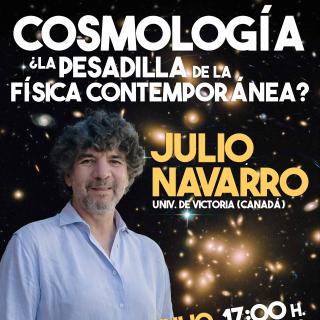
The renowned researcher, invited by the IAC as part of the Fundación Occident Visiting Researchers programme, will analyse the unresolved questions that still surround the origin and evolution of the Universe. On 10 July, at 17:00, the Museo de la Ciencia y el Cosmos will host the public lecture “Cosmology: the nightmare of contemporary Physics?”, delivered by the distinguished astronomer and cosmologist Julio Navarro, Professor at the University of Victoria, in Canada. The event forms part of his stay at the Instituto de Astrofísica de Canarias (IAC) within the Fundación Occident Visiting
The Instituto de Astrofísica de Canarias (IAC) continues to make progress in the construction of the SELF (Small ExoLife Finder) telescope with the arrival of its mechanical structure at the IACTec facilities. The structure, shipped from the Basque Country, marks a new milestone in the development of this scientific and technological project. The assembly has been received at the IACTec Building, located in the Las Mantecas Science and Technology Park (La Laguna, Santa Cruz de Tenerife), a strategic site dedicated to the design, integration and validation of advanced astronomical