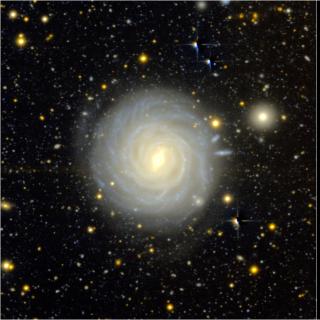
A new study published in Astronomy & Astrophysics unveils a powerful way to determine the size of dark matter haloes—the massive, invisible structures that host galaxies—by simply measuring how large galaxies appear in deep astronomical images. Researchers Ignacio Trujillo and Claudio Dalla Vecchia, from the Instituto de Astrofísica de Canarias (IAC) and the Universidad de La Laguna (ULL), demonstrate that galaxy size can serve as a precise proxy for halo size, offering measurements up to six times more accurate than previous methods. Using the cutting-edge EAGLE cosmological simulations
Researchers from the Instituto de Astrofísica de Canarias (IAC), in collaboration with the Instituto de Ciencias del Cosmos de la Universidad de Barcelona (ICCUB) and the Instituto de Estudios Espaciales de Cataluña (IEEC), have carried out the largest observational study to date on massive runaway stars including rotation and binarity in the Milky Way. This work, recently published in Astronomy & Astrophysics , sheds light on how these stellar “fugitives” are launched into space and what their properties reveal about their intriguing origins. Runaway stars are stars that travel through
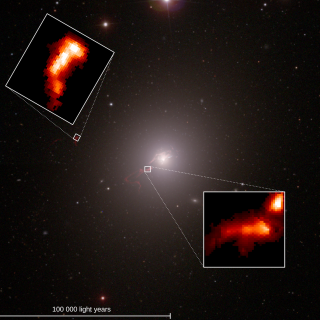
An international team of astronomers has captured the most detailed and completed view yet of the mysterious filaments surrounding the giant galaxy M87. Using new observations from the Gran Telescopio Canarias and the Canada-France-Hawaii Telescope, the study reveals how these long, thread-like structures move, evolve, and interact with their galactic environment and the activity of the central supermassive black hole. These findings have just been published in Monthly Notices of the Royal Astronomical Society. M87: a giant galaxy and its mysterious threads M87, located about 55 million