It may interest you
-
Researchers from the Instituto de Astrofísica de Canarias (IAC), in collaboration with the Instituto de Ciencias del Cosmos de la Universidad de Barcelona (ICCUB) and the Instituto de Estudios Espaciales de Cataluña (IEEC), have carried out the largest observational study to date on massive runaway stars including rotation and binarity in the Milky Way. This work, recently published in Astronomy & Astrophysics , sheds light on how these stellar “fugitives” are launched into space and what their properties reveal about their intriguing origins. Runaway stars are stars that travel throughAdvertised on -
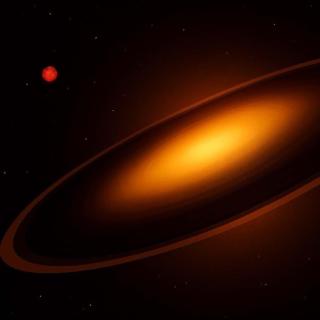
An international scientific team, involving the University of La Laguna (ULL) and the Instituto de Astrofísica de Canarias (IAC), has identified the cause of an unusually long dimming of a distant star . The phenomenon is explained by the passage of a substellar object with a giant ring system, similar to a ‘cosmic saucer’, in front of the host star. The star, named ASASSN-24fw, is located in the Monoceros constellation at about 3,000 light-years away from Earth. The star faded steadily for more than nine months between late 2024 and mid-2025 to about 97% dark before returning to its normalAdvertised on -
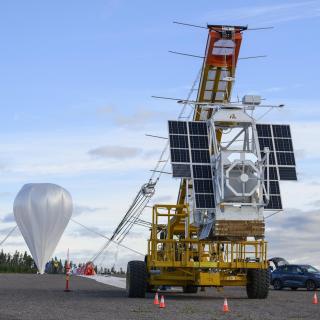
El Instituto de Astrofísica de Canarias (IAC) y la Universidad de La Laguna ULL) y participan en la misión internacional Sunrise III, un observatorio solar estratosférico transportado por globo que permite estudiar la parte inferior de la atmósfera solar, desde la superficie del Sol hasta la cromosfera media, con una resolución espacial cercana a los 50 kilómetros sobre la superficie solar. En julio de 2024, Sunrise III completó con éxito un vuelo de casi una semana de duración, recorriendo la distancia que separa el norte de Suecia y el noroeste de Canadá, durante el cual recopiló alrededorAdvertised on