We present the detection of fullerenes C60 and C70 in the star-forming region IC 348 of the Perseus molecular cloud. Mid-IR vibrational transitions of C60 and C70 in emission are found in Spitzer IRS spectra of individual stars (LRLL 1, 2, 58), in the averaged spectrum of three other cluster stars (LRLL 21, 31, and 67) and in spectra obtained at four interstellar locations distributed across the IC 348 region. Fullerene bands appear widely distributed in this region with higher strength in the lines of sight of stars at the core of the cluster. Emission features consistent with the three most intense bands of the C60+ and with one of C60- are also found in several spectra, and if ascribed to these ionized species it would imply ionization fractions at 20 and 10 per cent, respectively. The stars under consideration host protoplanetary discs, however the spatial resolution of the spectra is not sufficient to disentangle the presence of fullerenes in them. If fullerene abundances in the cloud were representative of IC 348 protoplanetary discs, C60, the more abundant of the two species, could host 0.1 per cent of the total available carbon in the discs. This should encourage dedicated searches in young discs with upcoming facilities such as the JWST. Fullerenes provide a reservoir of pentagonal and hexagonal carbon rings which could be important as building blocks of prebiotic molecules. Accretion of these robust molecules in early phases of planet formation may contribute to the formation of complex organic molecules in young planets.
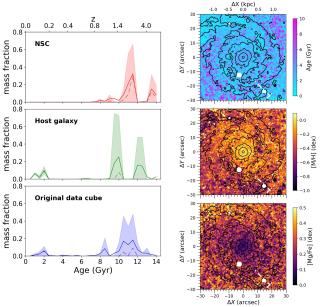
Averaged Spitzer spectra in the MIR of LRLL 21, 31 and 67, solid line and 4 interstellar locations (broken line) in IC348. The location of Fullerenes, organic molecules and water are indicated.
It may interest you
-
Type 2 quasars (QSO2s) are active galactic nuclei (AGN) seen through a significant amount of dust and gas that obscures the central supermassive black hole and the broad-line region. Here, we present new mid-infrared spectra of the central kiloparsec of five optically selected QSO2s at redshift z ∼ 0.1 obtained with the Medium Resolution Spectrometer module of the Mid-Infrared Instrument (MIRI) aboard the James Webb Space Telescope (JWST). These QSO2s belong to the Quasar Feedback (QSOFEED) sample, and they have bolometric luminosities of log L bol = 45.5 to 46.0 erg s −1 , global starAdvertised on -
The Instituto de Astrofísica de Canarias (IAC) has received a visit from Robert P. Kirshner, Executive Director of the Thirty Meter Telescope International Observatory (TIO) . During his stay at the IAC headquarters in La Laguna, he was welcomed by the center’s director, Valentín Martínez Pillet, and by the deputy director, Eva Villaver Sobrino, along with other members of the research institute. During his visit, he was able to learn firsthand about the institution’s scientific and technological capabilities and gave a colloquium titled The Thirty Meter Telescope and Science of the FutureAdvertised on -
A multidisciplinary team of astrophysicists, neuroscientists, engineers, and musicians has unveiled a pioneering method to “listen” to the structure of the human brain. Published in Nature Scientific Reports , the study presents the first higher-order sonification applied to structural magnetic resonance imaging (MRI) data. This technique involves transforming three-dimensional information about the brain into sound, taking into account the spatial relationships and complex structure of the data. To do this, mathematical tools originally developed to study the large-scale structure of theAdvertised on