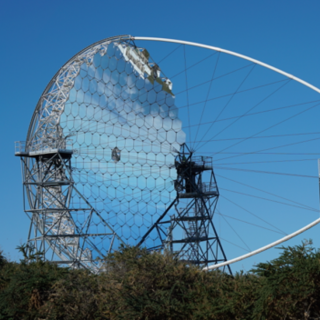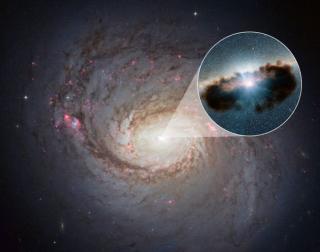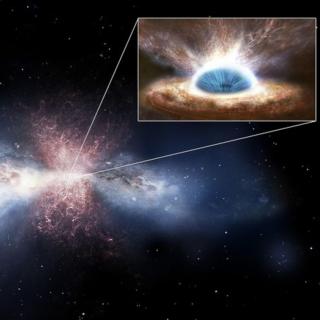

Conceptual illustration comparing the bright (left) and faint (right) phases of a supermassive black hole. Upper panels show the host galaxy with the active galactic nuclei (AGN) at the center; lower panels zoom into the central region around the supermassive black hole. In the bright phase the accretion disk (pale bluish region) and surrounding dusty torus are luminous, while reduced gas inflow to the black hole leads to an overall dimming.
An international team of astronomers, including researchers from the Instituto de Astrofísica de Canarias (IAC) and the Gran Telescopio Canarias (GTC), has observed a dramatic change in a supermassive black hole. Located about 10 billion light-years away, the object dimmed to roughly one-twentieth of its former brightness in just two decades — an extraordinarily short interval on cosmic timescales.
The discovery was made within a collaborative observing framework linking Japan’s Subaru Telescope with the GTC in Spain’s Canary Islands at the Roque de los Muchachos Observatory, in La Palma, together with contributions from other observatories worldwide. By combining wide-field sky surveys with detailed follow-up observations, astronomers were able to reconstruct how the activity of this distant black hole evolved over time.
When a Cosmic Giant Runs Out of Fuel
At the centers of many galaxies lie supermassive black holes millions or even billions of times more massive than the Sun. When large amounts of gas fall toward them, the material forms a hot rotating disk that shines intensely across the Universe. These luminous regions are known as active galactic nuclei (AGN).
For decades, astronomers believed that such active phases lasted hundreds of thousands or even millions of years — far too long for major changes to be witnessed within a human lifetime. The new observations challenge that picture. “It is as if a powerful cosmic engine suddenly began to lose its fuel supply,” explains Tomoki Morokuma leader of the work from the Chiba Institute of Technology (Japan). “We are seeing strong evidence that the flow of gas feeding the black hole dropped very rapidly.”
Not Simply a Trick of Light
Active black holes commonly show small fluctuations in brightness, and some systems dominated by powerful jets can vary dramatically over short periods. However, the new observations reveal a fundamentally different phenomenon. Using data ranging from optical and infrared light to radio and X-ray observations, the researchers found that the fading cannot be explained by dust temporarily blocking the view or by changes in jet emission. Instead, the evidence indicates that the accretion disk itself — the structure where gas spirals inward before falling into the black hole — became significantly weaker.
The team estimates that the rate at which matter flowed toward the black hole may have decreased by as much as fifty times within only a few years in the object’s own frame of reference. Such a rapid intrinsic change suggests a major disruption in the supply of gas reaching the galaxy’s center.
A Partnership Across the Globe
Detecting this rare event required comparing observations separated by decades. Wide-field imaging from Subaru first allowed astronomers to identify the unusual object by comparing modern observations with earlier sky surveys, including data from the Sloan Digital Sky Survey.
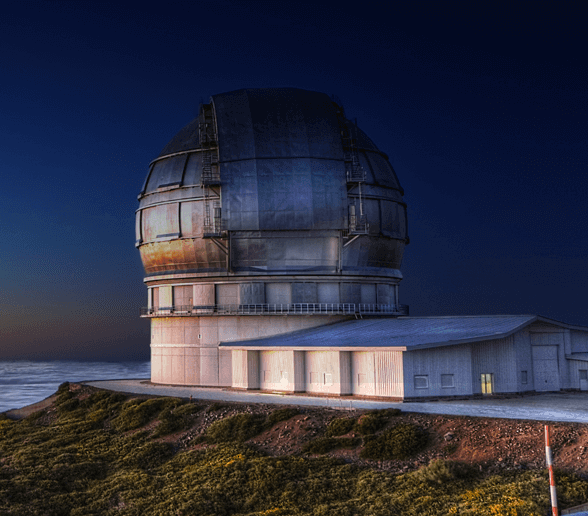
Follow-up observations with the Gran Telescopio Canarias — the world’s largest optical and infrared telescope — provided crucial measurements needed to understand how the black hole environment was evolving. “The GTC infrared observations data were fundamental in showing that the entire central engine was fading, not just part of it”, says Nieves Castro Rodríguez, an astronomer at the GTC and co-author of the article.
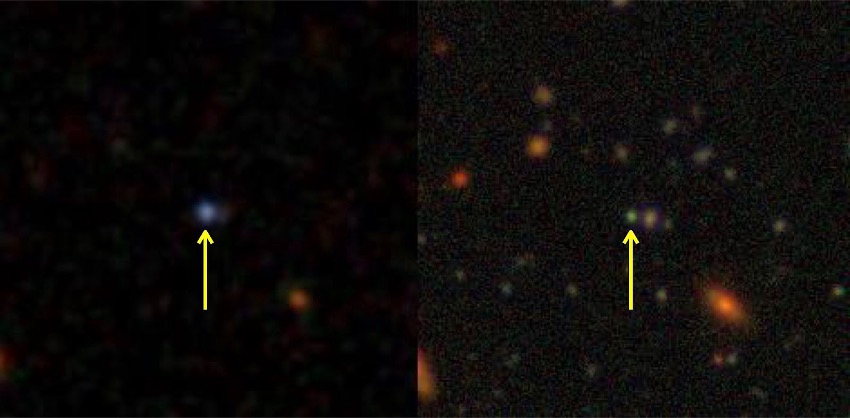
By combining the strengths of different observatories, researchers reconstructed the long-term history of the system and ruled out alternative explanations. “This discovery shows that only through international cooperation between observatories can we capture rare cosmic events that would otherwise pass completely unnoticed,” says Josefa Becerra González researcher at the IAC and co-author of the article.
Watching Black Holes Change in Real Time
In recent years, astronomers have begun discovering that some active black holes can undergo surprisingly rapid transformations. Previous studies have revealed dramatic changes in nearby active galaxies, suggesting that the growth of supermassive black holes may be far more dynamic than once believed.
“We used to think that supermassive black holes changed only over extremely long timescales,” says José Acosta Pulido, researcher at the IAC and co-author of the articles. “But this discovery, together with some previous findings on the very few changing-look active galactic nuclei, suggest that some of them can switch between active and quiet states in just a few years.”
A New Era of Discovery
Wide-field survey observations, which capture vast areas of the sky at once, have become a central approach in modern optical astronomy. This study demonstrates how combining data from different epochs and wavelengths can reveal long-term changes in galactic nuclei that would otherwise remain hidden.
With instruments such as Subaru’s Hyper Suprime-Cam and future high-sensitivity surveys like the Vera C. Rubin Observatory (LSST), Euclid, and NASA’s Nancy Grace Roman Space Telescope, astronomers expect to discover many more active galactic nuclei caught in low-activity — or even “turned-off” — states. Statistical studies of such objects will help reveal the physical conditions under which the gas supply to supermassive black holes stops or restarts, offering new insight into how these cosmic giants grow and influence their host galaxies.
At the same time, constructing new theoretical models capable of explaining the rapid changes observed in this study remains an important challenge for astrophysicists. Toshihiro Kawaguchi of the University of Toyama, who contributed primarily to the theoretical interpretation, added: “This object shows changes too rapid to be explained by standard models, and will serve as a touchstone when constructing new theoretical frameworks. We will investigate what physical conditions can reproduce the observed data.”
Each new discovery brings scientists closer to answering one of the fundamental questions of modern astronomy: how the Universe’s largest black holes grow — and how they stop.
Article: Tomoki Morokuma et al. “A possible shutting-down event of mass accretion in an active galactic nucleus at z~1.8”, Publications of the Astronomical Society of Japan (PASJ), Volume 77, Issue 6, 2025. DOI: https://doi.org/10.1093/pasj/psaf115
Contact at the IAC:
Josefa Becerra González, jbecerragonzalez [at] gmail.com (jbecerragonzalez[at]gmail[dot]com)
José Acosta Pulido, jose.acosta [at] iac.es (jose[dot]acosta[at]iac[dot]es)