
The Instituto de Astrofísica de Canarias (IAC) will host the Final COST NanoSpace Joint Scientific Meeting (CA21126) from 15 to 17 September (at the IACTEC facilities). The international meeting will bring together researchers and innovators from different disciplines to study carbon-based molecular nanostructures in space and explore their potential applications.
The COST Action NanoSpace brings together researchers from 67 countries, along with several industrial partners. It promotes a multidisciplinary approach to advancing our understanding of the physics and chemistry of carbon nanomaterials in space environments. To achieve this, the Action combines the latest developments in observational astronomy—including the capabilities of the James Webb Space Telescope (JWST)—with laboratory experiments, ground-based facilities capable of simulating interstellar and circumstellar environments, and recent advances in computational tools and experimental techniques.
Over three days, the meeting will bring together the main scientific results achieved throughout the COST Action (2022-2026) and foster exchange among researchers working in fields including laboratory astrophysics, theoretical chemistry and physics, astronomy, astrobiology, and materials science, among others.
From interstellar space to technological applications
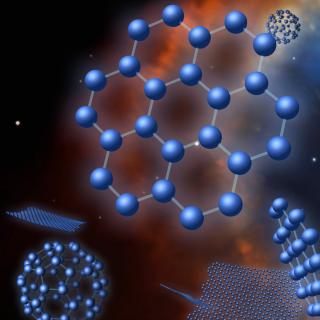
The meeting will focus on the fundamental and applied study of a range of carbon-based molecular nanostructures, including fullerenes, graphene, carbon nanotubes, and their derivatives. Researchers will address questions related to their formation, evolution, and properties, as well as their behaviour under space-relevant conditions.
The scientific sessions will be structured around the main NanoSpace Working Groups and will cover topics including nanocarbon formation and characterisation, resistance to space radiation, astrobiology and planetary science, laboratory studies, and potential technological and industrial applications.
By bringing together experimental results, theoretical models, and astronomical observations, the meeting will provide an opportunity to consolidate the advances achieved during the Action and explore new avenues for interdisciplinary collaboration.
“One of NanoSpace’s greatest strengths has been bringing together researchers from very different fields to address the same scientific questions from complementary perspectives. This final meeting is an opportunity to consolidate the knowledge generated throughout the Action and establish new collaborations for the future,” says Dr Aníbal García Hernández, IAC researcher and Chair of the COST Action NanoSpace..
An international network to study cosmic carbon
The main objective of the COST Action NanoSpace is to advance our understanding of the physics and chemistry of cosmic carbon nanomaterials and their relevance in non-terrestrial environments. Among the key questions addressed by the Action are which nanocarbon species are present in space and how they can be identified; which chemical processes lead to their formation and destruction; and what role they may play in cosmic environments and in prebiotic chemistry relevant to astrobiology.
To address these challenges, NanoSpace brings together expertise from a wide range of disciplines, including observational astronomy, laboratory astrophysics, astrobiology, theoretical and synthetic chemistry, molecular reaction dynamics, materials science, spectroscopy, graph theory, and data science and artificial intelligence.
The final meeting will also place particular emphasis on the participation of young researchers and scientists from countries included in COST’s inclusiveness initiatives, helping to strengthen international scientific collaboration and create new opportunities for the next generation of researchers.
In addition to the scientific sessions, the programme will include special sessions devoted to the NanoSpace Knowledge Hub, outreach and training activities such as NanoSpace Games, and a session exploring NanoSpace’s links with industry, with the aim of identifying opportunities to transfer the knowledge generated by the Action into new applications.
About the COST Action NanoSpace (CA21126) NanoSpace is a COST Action funded by the European Union that brings together researchers and innovators from 67 countries to study the abundance, formation mechanisms, and astrochemical and astrobiological role of carbon nanostructures in space. It is coordinated from the Instituto de Astrofísica de Canarias (IAC) by Dr Aníbal García Hernández. Further information: https://research.iac.es/proyecto/nanospace/ |
Further information:
https://meetings.iac.es/nanospacefjsm2026/