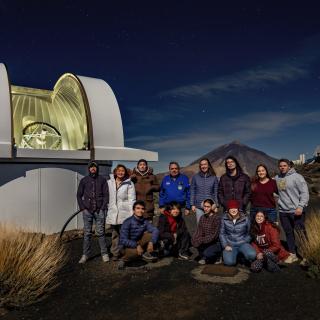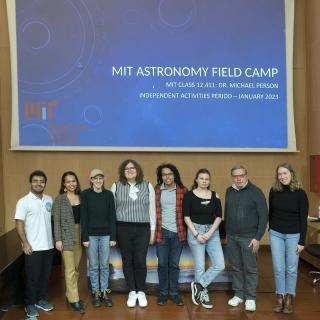

This January, the Instituto de Astrofísica de Canarias hosted, for the fourth time, the MIT Astronomy Field Camp, the historic science camp that the Massachusetts Institute of Technology (MIT), considered one of the best and most influential universities in the world, offers its planetary science and astronomy students with the aim of providing them with real experience of working in a professional observatory. On this occasion, nine students spent three weeks at the Teide Observatory in Tenerife, where they carried out various astronomical observations.
This activity, coordinated by MIT planetary scientist Michael Person, was launched in 2023 with the first camp held in Tenerife, marking the beginning of a new phase in the history of this renowned programme, which has been running for more than four decades. The initiative is part of the scientific projects and collaboration that MIT and the IAC have maintained for years, such as, among others, within the framework of the SPECULOOS network and its Artemis telescope at the Teide Observatory.
Under the guidance of research and engineering staff from the IAC and the observatory, the students were able to develop their skills in telescope operation and data analysis, accessing the various facilities at the Teide Observatory where they carried out observations for their research projects. During their stay, they also enjoyed a guided tour given by IAC astrophysicist Alfred Rosenberg, researcher Pere Luis Pallé and telescope operator Antonio Pimienta.
A joint scientific conference
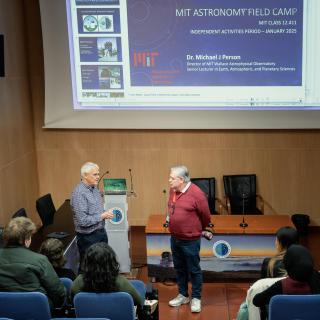
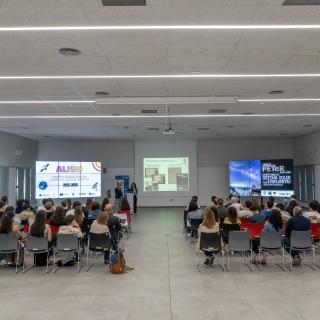
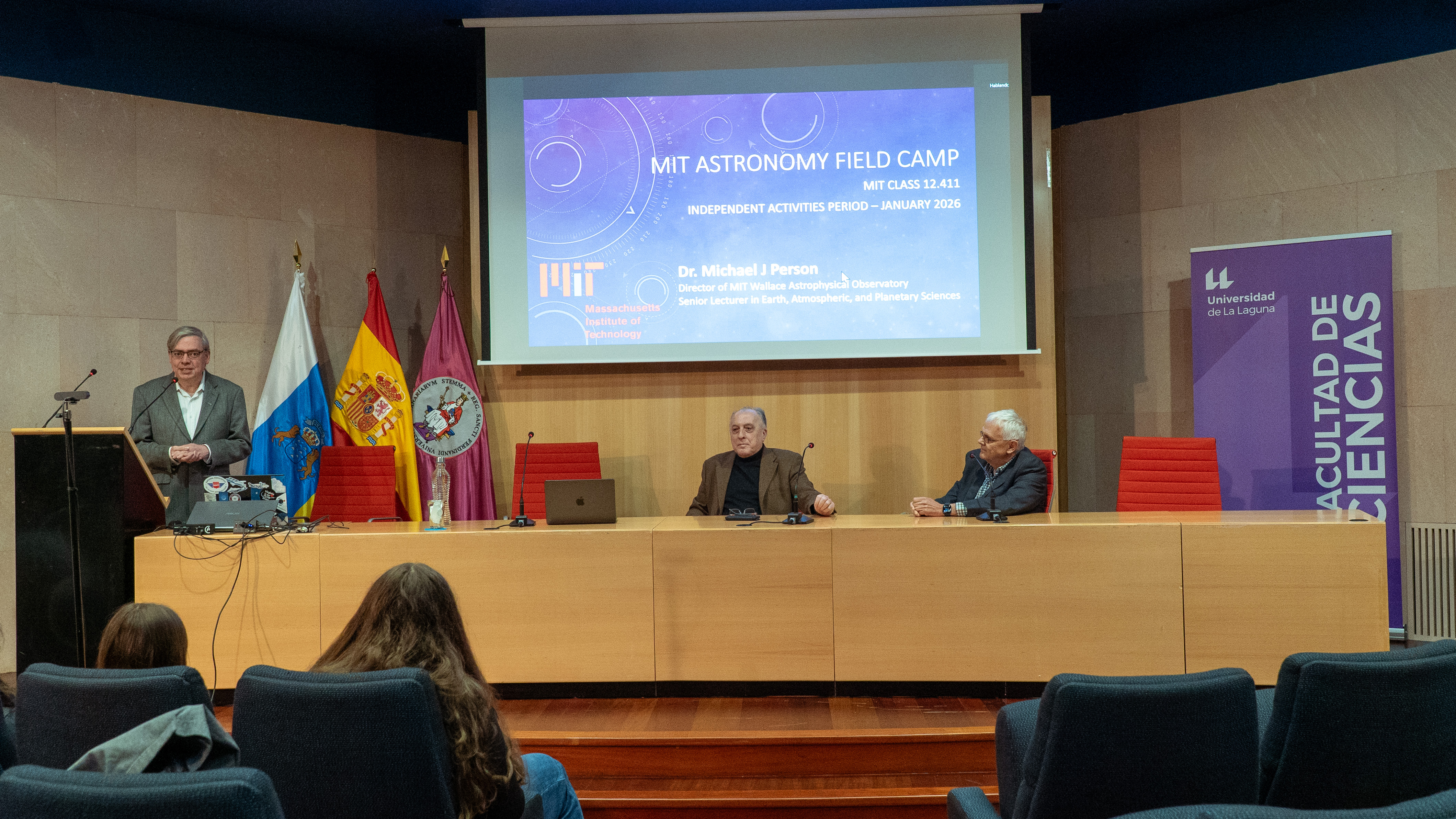
Before departing on 28 January, students from this prestigious institution presented the scientific results obtained during their stay at the Teide Observatory in the Aula Magna of the Faculty of Physics at the University of La Laguna (ULL). The session featured presentations by nine MIT students interspersed with those of nine doctoral students from the ULL-IAC, in an enriching scientific exchange between the two institutions.
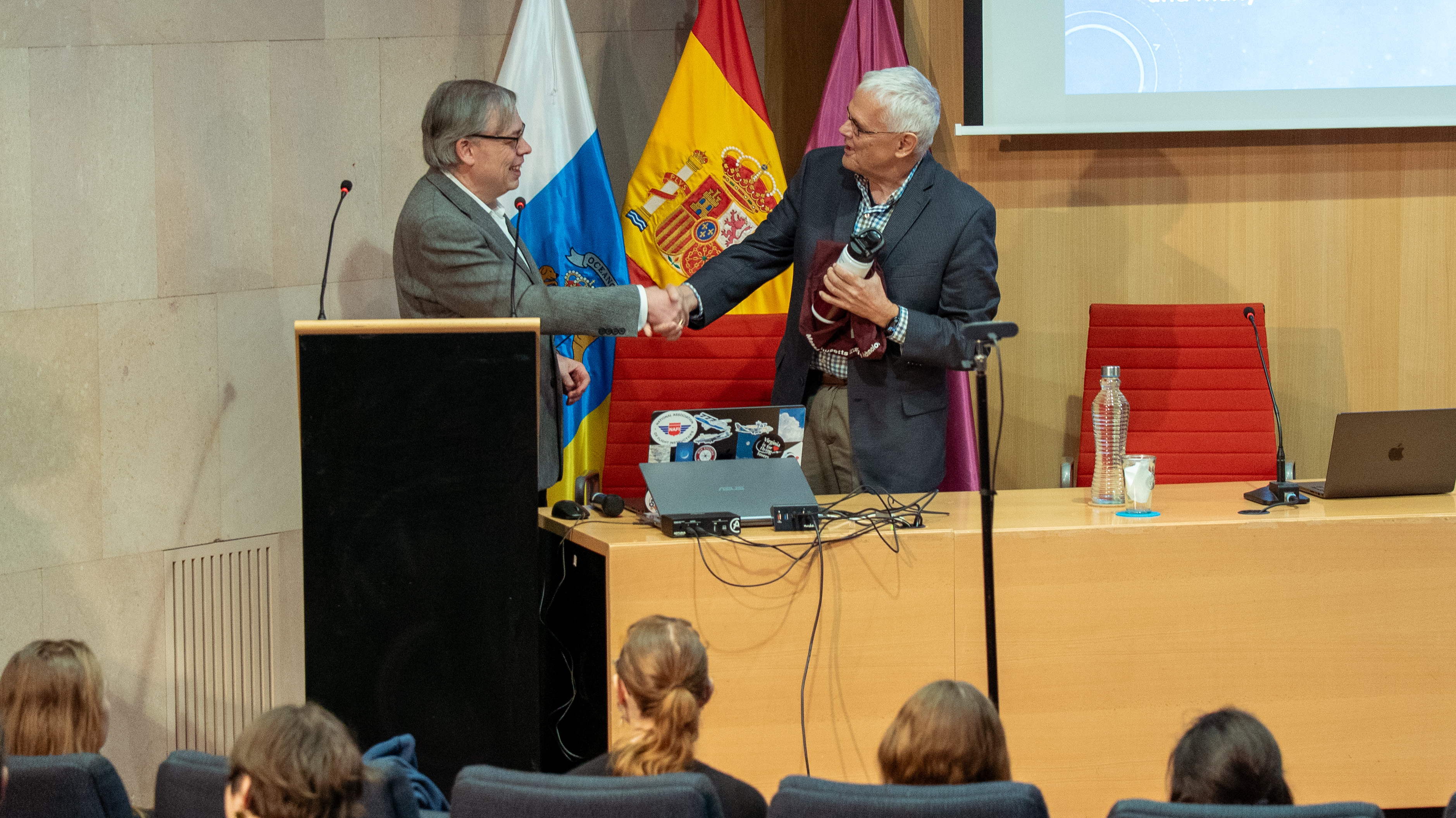
The talks given by MIT students covered a wide variety of astronomical topics: Lucy Gray presented her findings on the rotation periods of four asteroids from the Koronis family observed from Teide; Victoria Sconce presented aperture photometry techniques for extracting rotation periods of near-Earth asteroids; McKenzie Coleman has photometrically analysed the ultra-cool brown dwarf CFHT-BD Tau 4 in multiple bands; Layna Oberg and Oluyinka Lindblad have shared joint research on six potential exoplanets and their transits; Ryan Trujillo demonstrated methods of rapid astrometry of near-Earth objects for planetary defence using Python; Elaine Sheffield showed her PSF subtraction photometry work on the close-orbiting brown dwarf VHS-1256b; Parimala Rajesh presented orbital calculations for the system formed by the brown dwarf and the M dwarf G196-3; and Katherine Panebianco has presented images of the galaxy SDSS J095706.49+360439.6 obtained from the Teide Observatory.
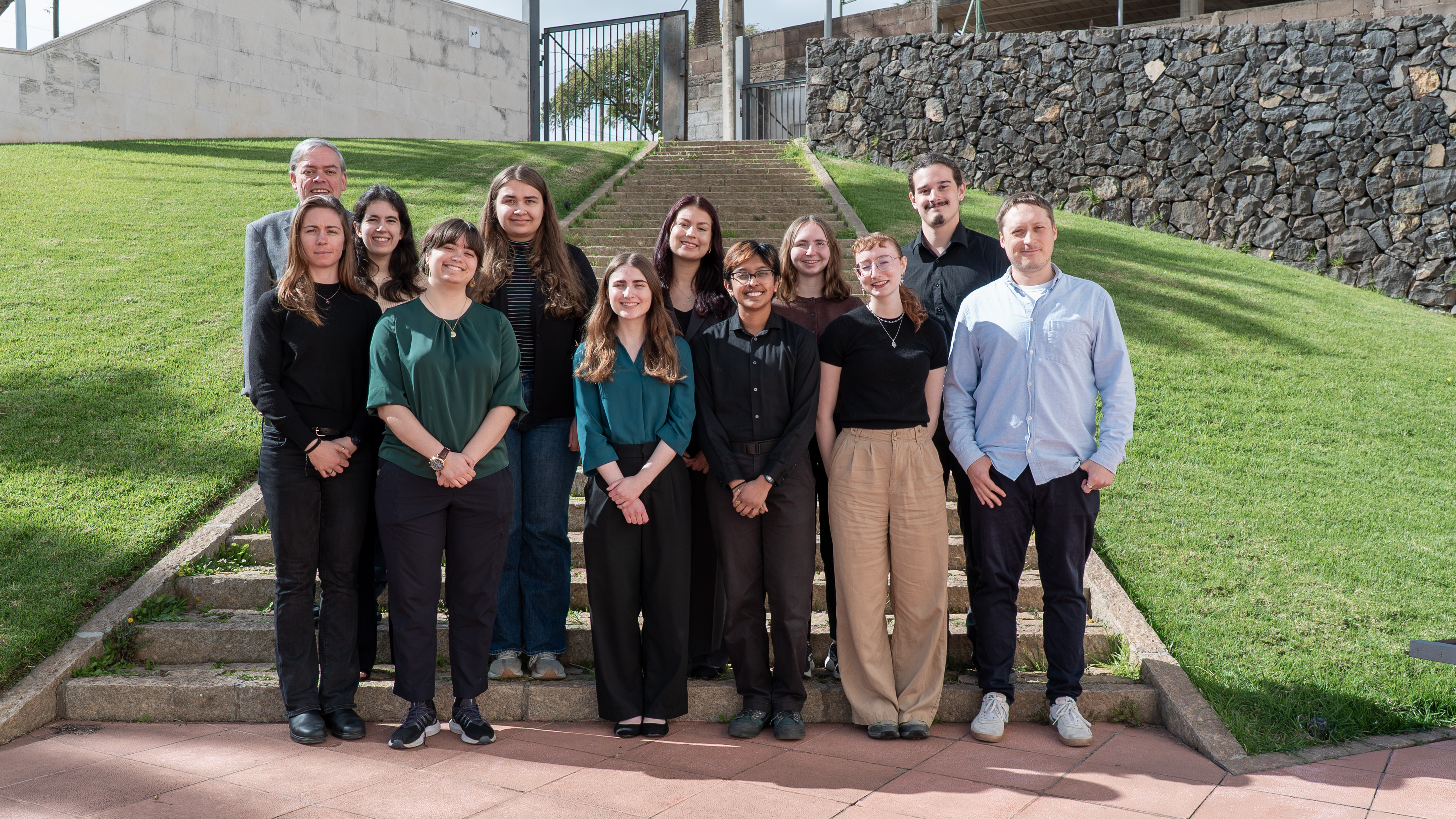
For their part, PhD students from the ULL-IAC presented equally diverse research: Atanas Stefanov spoke about a super-Earth in the habitable zone of GJ 3998; Desmond Grossmann explained the determination of stellar ages through asteroseismic modelling of solar-type stars; Matías Koll Pistarini showed solar vortices in 3D MHD numerical simulations; Diego Portero Rodríguez presented interferometric wavefront sensing techniques using integrated photonic circuits; Carlos Marrero de la Rosa discussed the formation of galaxies similar to the Milky Way; Patricia Iglesias Navarro presented the use of artificial intelligence to study structural transformations of galaxies in the JWST era; Jorge Sarrato Alós demonstrated the application of machine learning to infer dark matter density profiles in galaxy simulations; Luis Barrios Jiménez presented the study of galactic gamma-ray emitters with Cherenkov telescopes; and Elena Arjona Gálvez analysed the impact of active galactic nuclei in the low-mass regime.