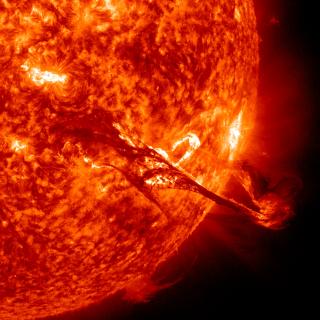

Schematic cutaway of the Sun. The right half shows the magnetic activity of the solar surface observed in the extreme ultraviolet, where coronal loops and magnetically dominated active regions are revealed. The left half shows the solar interior by “opening” the surface, illustrating the variation of the rotation rate with depth and latitude. The region marked with dashed blue lines corresponds to the tachocline, a transition layer located at a depth of about 200,000 km, where a strong variation in the rotation rate occurs. In this work, we describe the structure and dimensions of this region in greater detail than previously achieved. The solar magnetic field is powered by the strong rotational shear and the dynamical complexity of the tachocline. The magnetic activity observed at the solar surface originates in this deep layer of the Sun’s interior. Image credit: Gabriel Pérez Díaz (IAC).
An international team composed of Drs. Sylvain G. Korzennik, from the Center for Astrophysics | Harvard & Smithsonian, and Antonio Eff-Darwich Peña, from the University of La Laguna and the Instituto de Astrofísica de Canarias, has published a pioneering study aimed at improving our understanding of the Sun’s internal structure. The work, published in The Astrophysical Journal, stands out for its use of exceptionally long helioseismic time series, exceeding twenty-five years of continuous observations, to analyze the deepest layers of the Sun.
Helioseismology is the study of patterns of oscillations on the solar surface over time. Much like any musical instrument, the characteristics of these vibrations depend on the physical properties of the Sun's interior. The work focuses specifically on the solar tachocline, a thin region located about two hundred thousand kilometers beneath the solar surface, where temperatures reach roughly two million degrees Celsius. Within this layer, the transition between two distinct rotation regimes takes place—a phenomenon that is key to understanding fundamental processes such as the generation of the solar magnetic field and the mechanisms that drive the activity cycle of the Sun.
By characterizing this transition layer with unprecedented precision, the research addresses one of the classical challenges of solar physics. To achieve this precision, the researchers analyzed data from three complementary instruments: (i) the ground-based GONG network, operated by the National Solar Observatory, including one of the six instruments located at the Teide Observatory; (ii) the MDI instrument on board the ESA/NASA Solar and Heliospheric Observatory (SOHO) spacecraft; and (iii) the HMI instrument on board NASA’s Solar Dynamics Observatory (SDO) spacecraft.
Processing this massive volume of information required the use of innovative numerical techniques specifically designed for this study, including the simultaneous algebraic reconstruction method and the implementation of computational grids with a much higher radial density than is typically used. These methodologies made it possible to improve the resolution of the results while keeping the amplification of the observational noise under control, an essential aspect when studying structures as subtle and deep as the tachocline. Reflecting on the significance of this type of work, Dr. Eff-Darwich noted: “I still find it incredible that we are able to explore what is happening hundreds of thousands of kilometers beneath the surface of the Sun, which itself is about 150 million kilometers away from us.”
Beyond their relevance for fundamental physics, studies of this kind are essential for properly understanding space weather, namely the monitoring of the impact of the Sun’s magnetic activity on the Earth. The tachocline is closely linked to the processes responsible for solar magnetism which, when emerging at the surface, trigger solar storms and coronal mass ejections that affect our technological infrastructure. Among its findings, the study suggests that the position of the tachocline shows a discontinuity between low and high latitudes, revealing a more complex internal structure than previously assumed. The scientists’ reasonable inferences also indicate that this layer could be extremely thin, possibly less than one percent of the solar radius.
The work further explores potential temporal variations and concludes that, although the available data do not yet allow the definitive detection of changes with solar activity levels, continued development of these analytical tools is necessary to deepen our understanding of the Sun’s internal dynamics, and to improve our ability to understand and thus anticipate the effects of solar activity on the Earth. In the words of Dr. Korzennik "This new measurement will further puzzle theoreticians and modellers when trying to explain why the tachocline is the way it is."
Artículo: Korzennik & Eff-Darwich "Resolving the Tachocline using Inversion of Rotational Splitting Derived from Fitting Very Long and Long Time Series", ApJ (2026). DOI: https://doi.org/10.3847/1538-4357/ae4026
Contacto en la ULL/IAC:
Antonio Eff-Darwich, adarwich [at] ull.edu.es (adarwich[at]ull[dot]edu[dot]es)