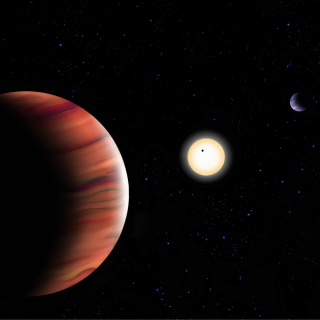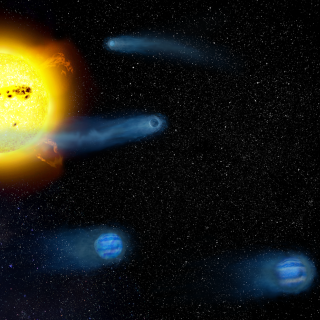

The Instituto de Astrofísica de Canarias (IAC) is taking part in an international study, published in the journal "Science", which provides the first conclusive evidence of a planet’s influence on the behaviour of its star. The results have made it possible to detect and estimate the strength of the magnetic field of the exoplanet GJ 436 b, opening up a new avenue for studying the habitability of planets outside the Solar System.
Magnetic fields play a fundamental role in the habitability of planets. On Earth, the magnetic field acts as a shield against the solar wind and contributes to the evolution of its atmosphere, a key condition for the existence of life. However, detecting and measuring these magnetic fields on planets outside the Solar System remains one of the great challenges of astronomy.
Now, a study published in the journal Science, led by the Andalusian Institute of Astrophysics (IAA-CSIC) and involving researchers from the IAC, demonstrates conclusively for the first time that a planet can directly influence the behaviour of its star. This finding provides the strongest evidence to date of the existence of a magnetic field on an exoplanet.
“In particular, we have observed that GJ 436 b, a Neptune-like exoplanet orbiting very close to its star, causes regular changes in the star’s brightness and the energy it emits at certain wavelengths,” explains Daniel Revilla, a researcher at the IAA-CSIC who is leading the study as part of his doctoral thesis.
Furthermore, by analysing how and when these variations in the star occur, “we have managed to estimate the strength of the magnetic field of a planet of this type, which in the future, and with much more advanced instrumentation, may open up a new avenue for studying the properties and habitability of worlds beyond the Solar System,” explains Enric Pallé, a researcher at the IAC and co-author of the study.
Magnetic fields beyond the Solar System
The presence of a magnetic field can influence a planet’s evolution, as it modulates the interaction between the stellar wind and the planetary atmosphere, thereby affecting processes related to the planet’s habitability. Earth is an example of this. Mars, by contrast, lost its intense global magnetic field billions of years ago, which contributed to the gradual loss of its atmosphere and, with it, much of the water it once harboured.
Determining whether exoplanets possess magnetic fields is therefore a key factor in assessing their potential habitability. In this context, the study has analysed sixteen years of high-resolution spectroscopic observations of the GJ 436 system, a low-mass star around which GJ 436 b orbits—a Neptune-like planet that orbits very close to its star. The results provide new insights into the presence of magnetic fields on worlds beyond the Solar System.
“Until recently, it was thought that it was primarily the star that influenced the planet, but our results provide the clearest evidence to date of something that had already been suspected: that the opposite can also occur, and that a nearby planet can alter its star’s environment,” says Rafael Luque, a researcher at the IAA-CSIC who is involved in the study.
The results show that, although stars usually dominate the relationship with their planets through their gravity, radiation and magnetic field, a planet orbiting very close to its star can also influence it. In the case of GJ 436 b, this interaction leaves observable signs that have made it possible to infer the existence and strength of its magnetic field.
“The observations, obtained using the CARMENES and HARPS spectrographs, reveal that the magnetic field of GJ 436 b interacts with that of its star and injects energy into the chromosphere—one of the upper layers of its atmosphere—thereby increasing its activity,” explains Pallé. “This process generates a phenomenon comparable to Earth’s auroras, but on a stellar scale,” he clarifies.
A key period
The interaction between the planet and the star is not observed continuously. The phenomenon has only been detected in 2008, 2016 and 2024 – three episodes separated by intervals of eight years. This periodicity coincides with GJ 436’s magnetic activity cycle, suggesting that the interaction becomes particularly intense — or easier to detect — when the star passes through certain phases of its magnetic cycle.
Comparing these observations with theoretical models has enabled the team to estimate a property that is extremely difficult to measure in an exoplanet: the strength of its magnetic field. “Despite its smaller size, GJ 436 b is thought to have a magnetic field between 2.33 and 27 times stronger than Jupiter’s,” says Pedro J. Amado, co-author of the paper and a researcher at the IAA-CSIC.
This finding presents a unique opportunity to study the magnetic fields of planets outside the Solar System. Analysing these fields provides a better understanding of how they retain their atmospheres, what their internal structure is like, and how they evolve over time.
“Until now, measuring the magnetic field of an exoplanet was extremely difficult. This property is key to determining whether a planet can protect its atmosphere and, ultimately, whether it could become habitable,” concludes Daniel Revilla.
In addition to the Andalusian Institute of Astrophysics (IAA-CSIC) and the Canary Islands Institute of Astrophysics (IAC), the study involves the Centre for Astrobiology (CAB, CSIC-INTA), the Institut d’Estudis Espacials de Catalunya (IEEC), the Institute of Space Sciences (ICE-CSIC), and the University of the Balearic Islands (UIB). The study also brings together researchers from the United States, Italy, Israel, Germany and Cyprus.
Article: Daniel Revilla et al. ‘Planet-induced Modulation of Stellar Activity in GJ 436: A Look into a Warm Neptune’s Magnetism’, Science, 2026. DOI: https://doi.org/10.1126/science.adv3075
Contact at the IAC:
Enric Pallé, epalle [at] iac.es (epalle[at]iac[dot]es)