

General

Our group works on theoretical astroparticle physics and our goal is to expand our understanding of the fundamental laws of Nature by exploiting the synergies between astrophysical observations and laboratory experiments. Different lines we are currently working on are:
Indirect searches of dark matter: New light exotic particles coupled very weakly to the Standard Model (such as the axion or the dark photon) are suitable candidates of dark matter that could manifest through some distinctive signatures in astrophysical observations and laboratory searches. We are currently investigating and developing new strategies to shape observationaly the properties of such type of dark matter including (but not restricted to) stellar cooling of neutron stars and red giants, time series of polarization of pulsar emission and impact of this dark matter on small scale structure. We are also developing new theoretical models of dark matter which could simultaneously address baryogenesis or which could furnish theoretically dark photons.
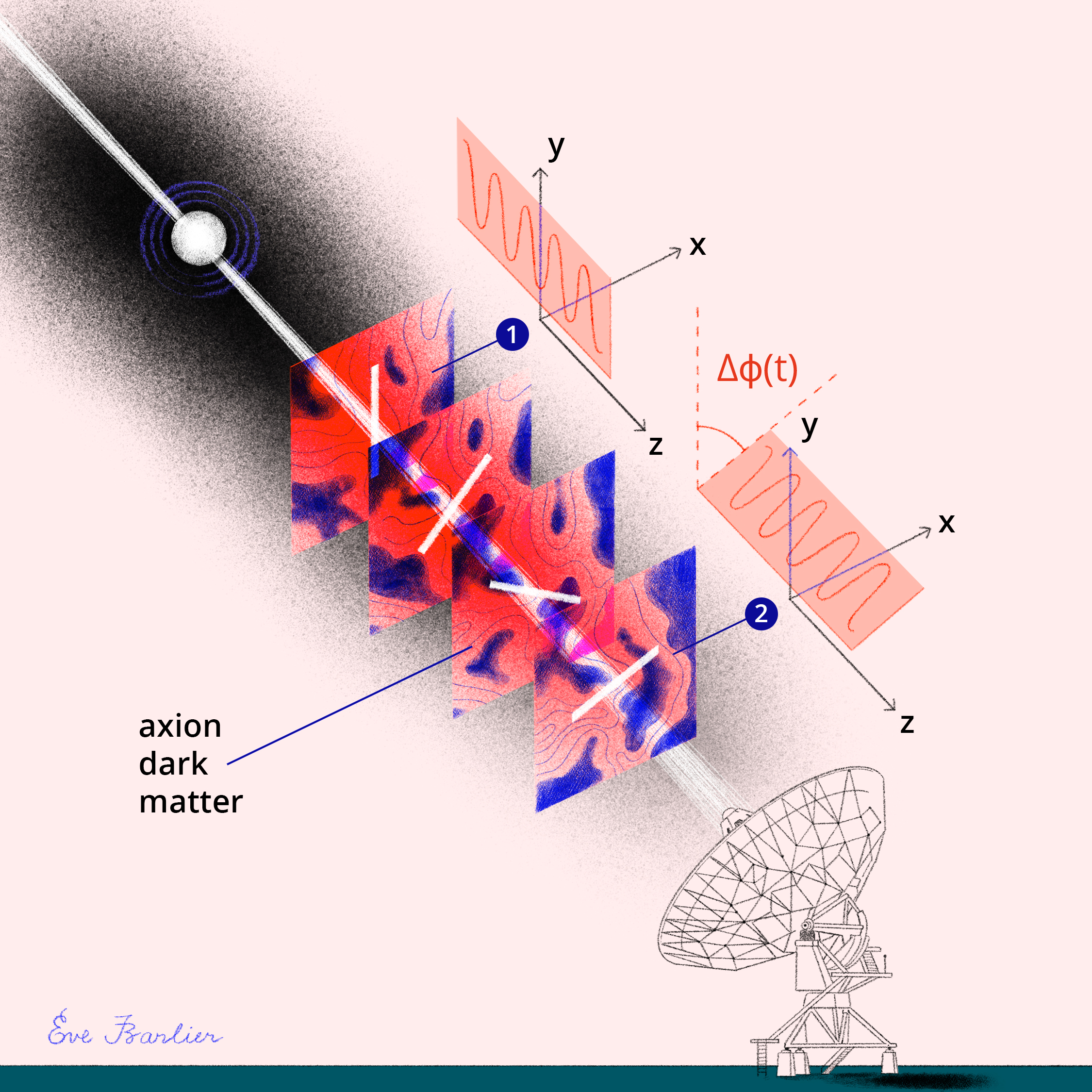
Birrefringence of a pulsar's polarized radio-wave emission induced by axion dark matter waves. New physics, flavor physics and dark sectors: experiments involving B meson decays developed at the Large Hadron Collider at CERN and at Belle II in Japan are very sensitive to the presence of new forces interacting with the heavier quarks of the Standard Model. This allows us to explore our understanding of the fundamental laws of physics at the smallest scales at which we have been able to observe. This would have consequences in the Early Universe, such as the existence of flavor-laden dark sectors, the production of topological defects or the introduction of new mechanisms to explain baryogenesis.
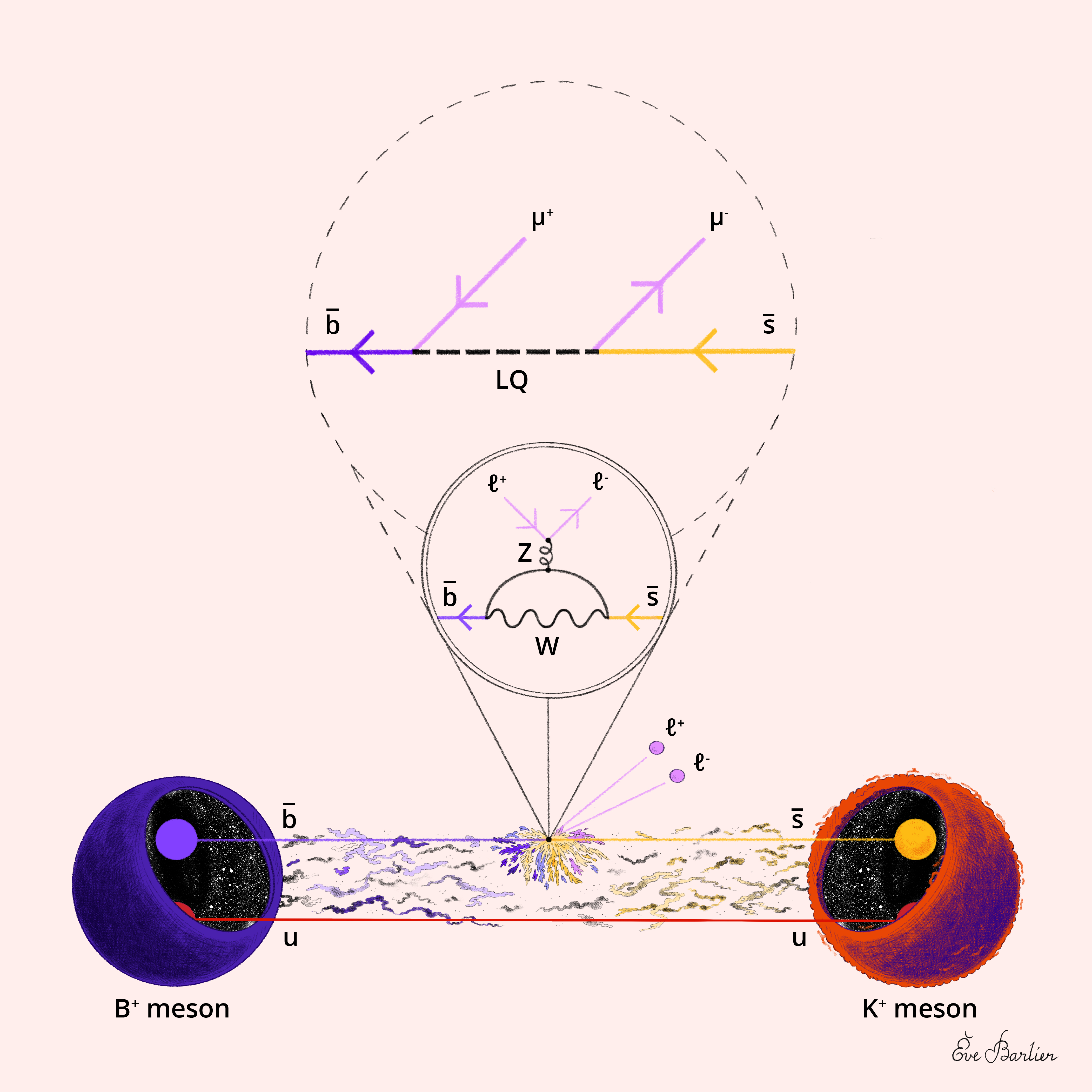
Contribution to the beauty quark decay induced by a super-heavy (m~30 TeV) and exotic particle called the leptoquark. - Fundamental Physics in high-energy gamma rays: We are exploring different strategies that could exploit the ultra-high energies of the gamma rays at observed by the space mission Fermi-LAT or expected to be observed at the Cherenkov Telescope Array (CTA).
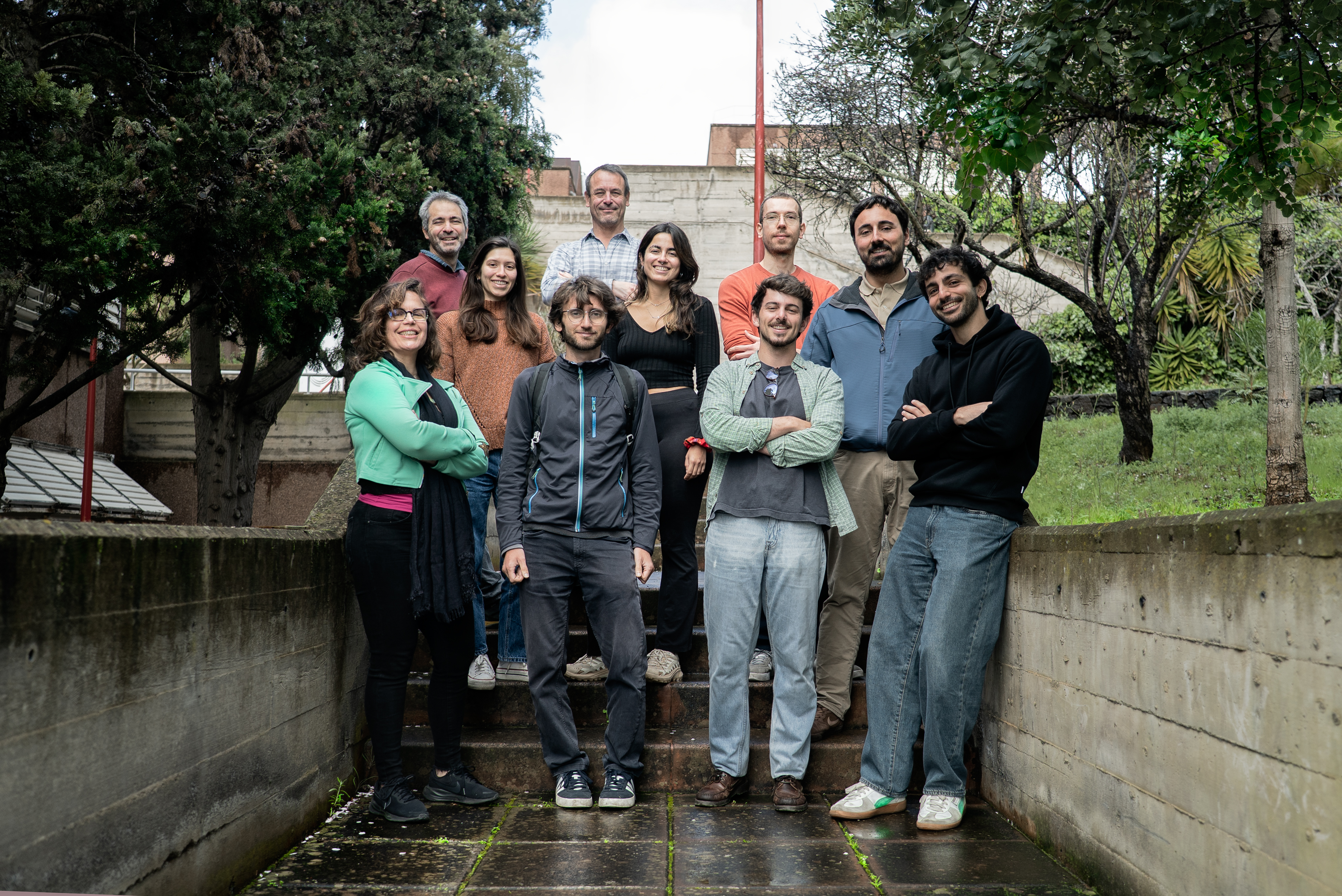
Our group currently consists of 2 Staff, Jorge Martin Camalich (Principal Investigator of astroparticle theory) and Carlos Hernandez-Monteagudo, 2 postdoc (Christopher Eckner and Luca Teodori) and 6 PhD students (Andrés Bañares, Alba Crespo, Mar Pérez, Fernando Valenciano, Elena Vanetti y Ruben Zatini). Other members of the group include UNDARK's project manager (Claudia Guerrero García-Hera) y scientific communicator (Raquel Conde). Please do not hesitate to contact us at jcamalich at iac.es if you would like to do a PhD with us, work with us or visit our group!
Members
Results
- Implications of new evidence for lepton-universality violation in b→sℓ+ℓ− decays, L. S. Geng, B. Grinstein, S. Jäger, J. Martin Camalich and R. Xiang-Shi, Phys. Rev. D, in print.
- Supernova Constraints on Dark Flavored Sectors, J. Martin Camalich, J. Terol-Calvo, L. Tolos, R. Ziegler,
- (g−2)e,μ in an extended inverse type-III seesaw model, P. Escribano, J. Terol-Calvo, A. Vicente,
Phys. Rev. D 103, 115018 - Scalar resonance in graviton-graviton scattering at high-energies: the graviball, D. Blas, J. Martin Camalich, J. A. Oller,
arXiv:2009.07817 [hep-th] - Quark Flavor Phenomenology of the QCD Axion, J. Martin Camalich, M. Pospelov, P. N. H. Vuong, R. Ziegler, J. Zupan,
Phys. Rev. D 102, 015023
Scientific activity
Related conferences
-
 XXXIII Canary Islands Winter School of Astrophysics: Astroparticle Physics and CosmologyThe XXXIII Canary Islands Winter School of Astrophysics, organized by the Instituto de Astrofísica de Canarias (IAC), focuses on Astroparticle Physics and Cosmology. The school, to be held in San"Salón de actos" at the Museo de la Ciencia y el Cosmos (MCC) Avda. Los Menceyes 70 38205 San Cristóbal de La LagunaSpainDate-Past

![Izquierda - Imagen RGB de la nebulosa de Orión y M43 obtenida filtros estrechos con la cámara WFC en el INT: H alfa (rojo), [S II] 6716+30 (verde), [O III] 5007 (azul). Derecha - Imagen en falso color de la nebulosa planetaria NGC 6778. En azul se ve la emisión en la línea de O II tomada con el filtro sintonizable azul del instrumento OSIRIS en el GTC; en verde imagen con el filtro estrecho de [O III] del Nordic Optical Telescope (NOT).](/sites/default/files/styles/crop_square_2_2_to_320px/public/images/project/imagen_web.jpg?itok=fsBmV9CO "Izquierda - Imagen RGB de la nebulosa de Orión y M43 obtenida filtros estrechos con la cámara WFC en el INT: H alfa (rojo), [S II] 6716+30 (verde), [O III] 5007 (azul). Derecha - Imagen en falso color de la nebulosa planetaria NGC 6778. En azul se ve la emisión en la línea de O II tomada con el filtro sintonizable azul del instrumento OSIRIS en el GTC; en verde imagen con el filtro estrecho de [O III] del Nordic Optical Telescope (NOT).")