
Bibcode
DOI
Bono, G.; Stetson, P. B.; Sanna, N.; Piersimoni, A.; Freyhammer, L. M.; Bouzid, Y.; Buonanno, R.; Calamida, A.; Caputo, F.; Corsi, C. E.; Di Cecco, A.; Dall'Ora, M.; Ferraro, I.; Iannicola, G.; Monelli, M.; Nonino, M.; Pulone, L.; Sterken, C.; Storm, J.; Tuvikene, T.; Walker, A. R.
Bibliographical reference
The Astrophysical Journal, Volume 686, Issue 2, pp. L87-L90.
Advertised on:
10
2008
Journal
Citations
50
Refereed citations
42
Description
We present precise optical and near-infrared ground-based photometry of
two globular clusters (GCs): ω Cen and 47 Tuc. These photometric
catalogs are unbiased in the red giant branch (RGB) region close to the
tip. We provide new estimates of the RGB tip (TRGB)
magnitudes-mI(TRGB)=9.84+/-0.05, ω Cen;
mI(TRGB)=9.46+/-0.06, 47 Tuc-and use these to determine the
relative distances of the two GCs. We find that distance ratios based on
different calibrations of the TRGB, the RR Lyrae stars, and kinematic
distances agree with each other within 1 σ. Absolute TRGB and RR
Lyrae distance moduli agree within 0.10-0.15 mag, while absolute
kinematic distance moduli are 0.2-0.3 mag smaller. Absolute distances to
47 Tuc based on the zero-age horizontal branch and on the white dwarf
fitting agree within 0.1 mag, but they are 0.1-0.3 mag smaller than TRGB
and RR Lyrae distances.
Based on observations made with ESO telescopes SOFI at NTT, La Silla;
ISAAC at VLT Paranal, projects: 66.D-0557, 68.D-0545, 075.D-0824,
79.D-0765 and on images obtained from the ESO/ST-ECF. Optical data were
also collected with the 1.0 m SAAO telescope, projects: 2006.1.012,
2006.2.02.
Related projects
Milky Way and Nearby Galaxies
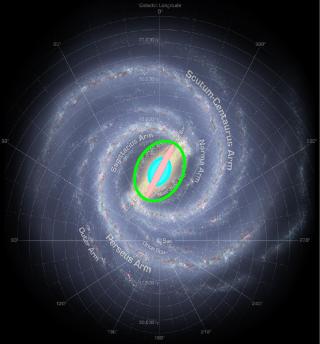
The overall aim of the project is to study the morphology, stellar populations, kinematics and dynamics (including formation and evolution) of the Milky Way and its satellite galaxies and other Local Group galaxies. The project can be divided into two main lines: I. Structure of the Milky Way and nearby galaxies. The detailed study of the
Martín
López Corredoira