The Canary Islands Institute of Astrophysics successfully tested its solar corona measurement equipment in Palencia, where thousands of people enjoyed the total solar eclipse

Advertised on

After months of work, the Canary Islands Institute of Astrophysics (IAC) successfully concluded its scientific, outreach, and educational program in Palencia, where thousands of people enjoyed the total solar eclipse on August 12, 2026.

The program, designed jointly by the IAC and the Palencia City Council, filled the streets and theaters throughout the province. This historic event concluded with a high turnout. Thousands of people—including locals and visitors from all over the world—packed the viewing areas set up in Palencia to enjoy a once-in-a-lifetime astronomical spectacle live.
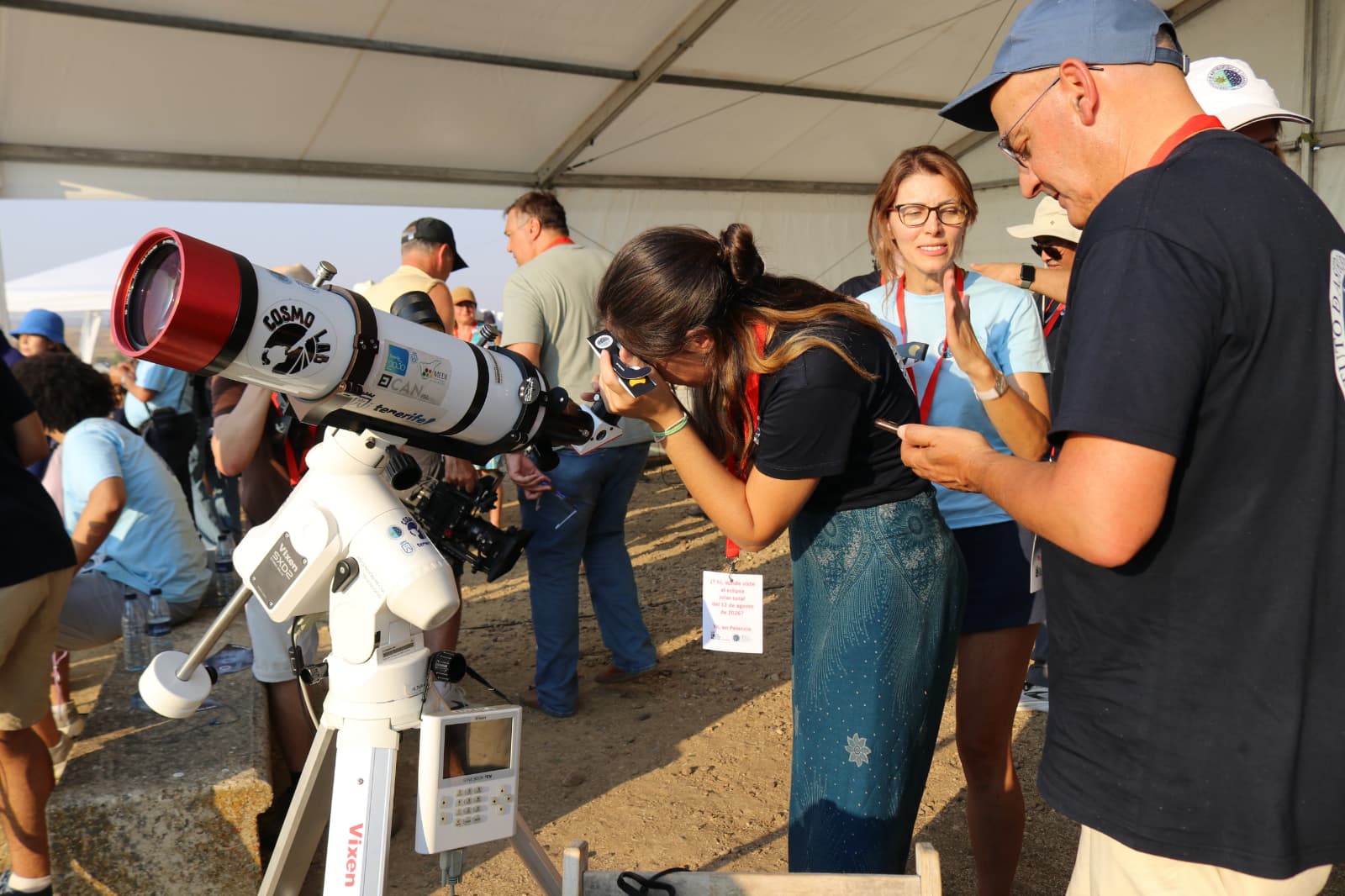
 

Equipo NATE preparando la observación del eclipse solar total de Palencia, el 12 de agosto de 2026
Uno de los equipos NATE, durante los preparativos para la observación del eclipse (Ayuntamiento de Palencia)


The event was not only a major public outreach milestone in the capital of Palencia and in towns such as Frómista, Carrión de los Condes, Osorno la Mayor, and Villalcázar de Sirga, but it also hosted a scientific experiment—NATE (North Africa Telescope Eclipse) experiment to measure the solar corona, led by the Canary Islands Institute of Astrophysics (IAC) in collaboration with Mohamed VI Polytechnic University and the National Solar Observatory (NSO) of the United States.

Goals Achieved

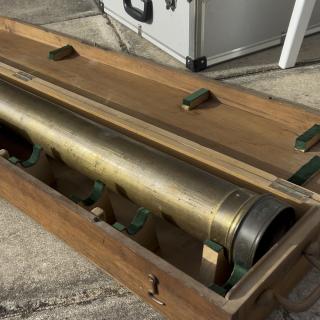
During the minutes of totality, the IAC’s scientific and technical team stationed in Palencia successfully met the objectives set for the expedition. The researchers conducted operational tests of the NATE project’s equipment, successfully capturing high-resolution images of the solar corona, which are essential for studying the Sun’s behavior. Likewise, the historic 1905 telescope, recently restored for the occasion, functioned flawlessly, successfully recording the solar corona at the moment of totality.

Once the Moon’s shadow had passed, the NATE project team began comparing the preliminary computer simulation of the solar corona with the actual images obtained in the field, finding a similarity of more than 70 percent—a result that will require further analysis.

An exceptional event

Migdalia Machín, the Canary Islands Government’s Minister of Universities, Science, Innovation, and Culture, who traveled to Palencia, stated that “we have experienced an exceptional event that has allowed us to see, once again, science’s ability to spark public interest and bring us closer to knowledge,” and she thanked “the scientists at the Canary Islands Institute of Astrophysics for their extraordinary work, as they now embark on an exciting new phase with the NATE project and with their sights set on the total eclipse of 2027 in Morocco!” “The Canary Islands have a world-class scientific community, and we have a responsibility to support their work and ensure that the knowledge generated here continues to reach ever farther,” Machín added.

The extensive educational program—which included talks by IAC Director Valentín Martínez Pillet, Deputy Director Eva Villaver, NSO physicists such as Kevin Reardon, and researchers such as Lindsay House, Jose Carlos del Toro Iniesta, Irene Puerto, Pablo Redondo, Juan Carlos Pérez Arencibia, Alejandra Goded, Jorge Pérez Gallego, and Gaia Lacedelli—thus brings the conference to a close and prepares for the next phase of the project in anticipation of the total solar eclipse on August 2, 2027, in Morocco.




More info
PRESENTACIÓN DEL PROGRAMA DIVULGATIVO NATE DEL ECLIPSE DE AGOSTO EN PALENCIA
Presentación del programa divulgativo NATE del eclipse de agosto en Palencia. Acogerá a físicos solares de referencia internacional integrantes del proyecto NATE, liderado por el Instituto de Astrofísica de Canarias (IAC). El amplio equipo de científicos participará en numerosas actividades divulgativas en diversos puntos de la capital y de la provincia.
Date
Related projects
Sequence of a total solar eclipse
NATE: Science that brings people together under the eclipses
The NATE project encompasses two eclipses, three countries—Spain, Morocco, and the United States—as well as scientists, students, volunteers (citizen scientists), the «emptied Spain», and an outermost island region, all in a shared pursuit of knowledge. The North African Telescope Eclipse (NATE) project, led by the Instituto de Astrofísica de
Valentín Juan
Martínez Pillet
Related news
Sequence of a total solar eclipse
On 12 August, to mark the total eclipse that will be visible across much of Spain, various towns in Palencia — including the capital, Frómista and Carrión de los Condes — will host a series of observation and outreach events bringing together scientists and students from Spain, Morocco and the United States. This event will serve as a training exercise for the NATE experiment, which will take place in North Africa during the next total eclipse next year, and will act as a meeting point between depopulated areas of Spain, the outermost regions, and Moroccan, American and Spanish students and
Advertised on
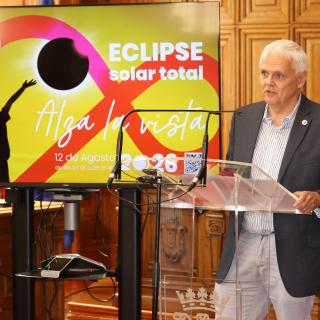
Valentín Martínez Pillet, Director of the IAC, speaks during the press conference presenting the NATE educational programme on the August eclipse in Palencia.
The Plenary Hall of the Palencia City Council hosted the presentation of the program of events surrounding the upcoming eclipse. This ambitious program of educational and artistic events was presented by the mayor of Palencia, Miriam Andrés Prieto; the director of the Canary Islands Institute of Astrophysics (IAC), Valentín Martínez Pillet; the councilor for Cultural Identity, Tourism, and Festivals, Francisco Fernández Asensio; and the deputy director of the IAC, Eva Villaver, a native of Palencia. In anticipation of the upcoming eclipse on August 12, Palencia will become Spain’s scientific
Advertised on
Telescopio 'Breton Frères, Paris' utilizado en Palencia durante el histórico eclipse solar total de 1905 y restaurado en el IAC para su uso en el eclipse del 12 de agosto de 2026
Más de un siglo después de haber permanecido olvidado en el desván de un monasterio, un telescopio histórico del siglo XIX vuelve a apuntar hacia el firmamento para captar un eclipse total de Sol. El instrumento, un refractor del reputado fabricante Breton Frères, Paris que formó parte del equipamiento científico desplegado en Palencia durante el histórico eclipse solar total de 1905. Ahora, se realizado una restauración conservativa, recuperando su funcionamiento mecánico y óptico y respetando al máximo sus elementos para adaptarlo y estar listo para incorporarse a las observaciones
Advertised on
Cerro and Cristo del Otero, in Palencia
On August 12, coinciding with the total solar eclipse that will be visible across much of Spain, the Canary Islands Institute of Astrophysics (IAC)—a world leader in solar physics—will bring together leading scientists in Palencia. Most of them are affiliated with the NATE project, spearheaded by the institute, and they will conduct their work in front of the public in what is set to become one of the most significant scientific and educational events to take place in the country. Thus, starting on the 10th, talks and workshops will be held at various locations throughout the city of
Advertised on
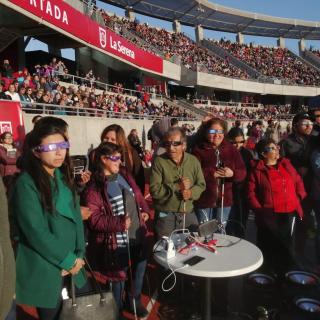
A group of people with visual impairments experiencing a total solar eclipse
As part of the program of initiatives that the IAC—in collaboration with the Palencia City Council and with the support of the Canary Islands Government, and as part of its NATE project—will carry out in Palencia to mark the total solar eclipse on August 12, people with visual impairments will be offered the opportunity to follow the event through the Inclusive Eclipse project of the Institute of Space Sciences (ICE-ISIC). This option will be available at a designated location on the grounds of the Cristo del Otero monument. In this sound art space, anyone can enjoy the eclipse through sound
Advertised on
Imagen de un eclipse total de Sol
Con motivo del eclipse solar total que se observará desde la Península el próximo 12 de agosto, el Instituto de Astrofísica de Canarias (IAC) desplegará un amplio equipo de investigadoras, investigadores y personal técnico en múltiples localidades españolas para desarrollar labores científicas, divulgativas y de observación del fenómeno. El epicentro de este despliegue estará en Palencia con el proyecto internacional NATE (North African Telescope Eclipse), liderado por el IAC en colaboración con la Universidad Mohammed VI Politécnica (UM6P) de Marruecos y el National Solar Observatory (NSO)
Advertised on
The Instituto de Astrofísica de Canarias (IAC) will broadcast a special program live and free of charge to mark the total solar eclipse via its official YouTube channel.
The Instituto de Astrofísica de Canarias (IAC) will broadcast a special program live and free of charge to mark the total solar eclipse via its official YouTube channel. The production and technical setup will be located at Cerro del Otero in Palencia, from where a program featuring science outreach, technical analysis, and institutional segments will be broadcast, with the goal of bringing cutting-edge astrophysics to the general public. The broadcast will be hosted by science journalist and head of the IAC’s Scientific Communication and Culture Unit, Verónica Martín, with support from IAC
Advertised on