Magnetism, Polarization and Radiative Transfer in Astrophysics

    General
    Description

    Magnetic fields pervade all astrophysical plasmas and govern most of the variability in the Universe at intermediate time scales. They are present in stars across the whole Hertzsprung-Russell diagram, in galaxies, and even perhaps in the intergalactic medium. Polarized light provides the most reliable source of information at our disposal for the remote sensing of astrophysical magnetic fields, including those on the Sun. In particular, the diagnostics of solar and stellar magnetic fields requires the measurement and physical interpretation of polarization signatures in spectral lines, which are induced by various physical mechanisms taking place at the atomic level. In addition to the familiar Zeeman effect, polarization can also be generated by various other physical processes, such as atomic level polarization induced by anisotropic pumping mechanisms, quantum interference between fine-structured or hyperfine-structured energy levels, the Hanle effect, etc. Interestingly, the polarization produced by such mechanisms is sensitive to the physical conditions of the astrophysical plasma under consideration and, in particular, to the presence of magnetic fields in a parameter domain that goes from field intensities as small as 1 micro-G to many thousands of Gauss.

    The main objective of this project is to explore in depth the physics and origin of polarized radiation in astrophysical plasmas as well as its diagnostic use for understanding cosmical magnetic fields, with emphasis on the magnetism of the extended solar atmosphere. Our investigations deal with:

    -the theoretical understanding of relevant polarization physics, which requires new insights into the quantum theory of polarized light scattering in the presence of magnetic and electric fields.

    -the development of plasma diagnostic tools for the investigation of astrophysical magnetic fields, with emphasis on the magnetism of the extended solar atmosphere, circumstellar envelopes and planetary nebulae.

    -spectropolarimetric observations and their physical interpretation.

    -radiative transfer in three-dimensional models of stellar atmospheres, resulting from magneto-hydrodynamical simulations.

    -atomic and molecular spectroscopy and spectro-polarimetry, with applications in several fields of astrophysics.

    This research project is formed by a group of scientists convinced of the importance of complementing theoretical and observational investigations in order to face some of the present challenges of 21st century Astrophysics.

    Principal investigator
    1. We applied deep learning techniques to the analysis of observations. Using convolutional neural networks, we developed techniques for the deconvolution of observational data. These techniques were also used to accelerate the deconvolution process of ground-based observations, achieving a cadence of around a hundred images processed per second.
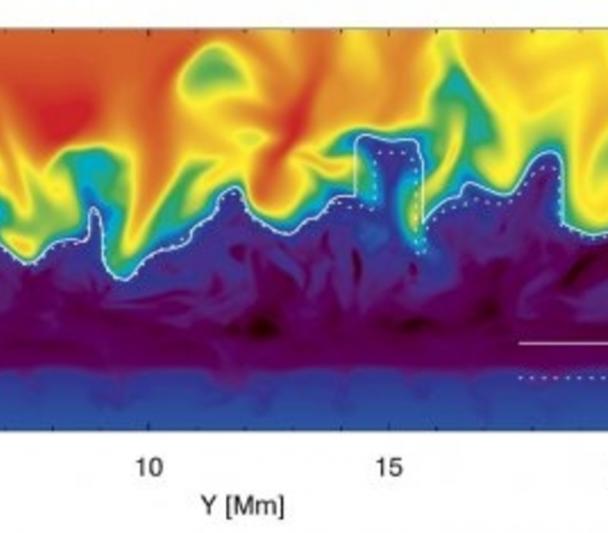
    2. We developed an inference technique based on bayesian statistics in order to interpret the observations provided by the CLASP international experiment. By parametrizing a state-of-the-art magneto-hydrodynamical model of the solar atmosphere, we found that the geometrical complexity of the transition region must be much more complex than the one provided by the model.
    3. We solved the problem of polarized radiation transfer in magneto-convection simulations that account for small-scale dynamo action for the Sr I line at 460.7 nm. We found that the model with most of the convection zone magnetized close to the equipartition and a surface mean field strength of 170G is compatible with the available observations.
    4. We studied the magnetic sensitivity of the Ca I line at 422.7nm. The linear polarization at the core is sensitive to the Hanle effect, while the linear polarization in the wings is sensitive to the magneto-optical effects, as a consequence of the newly found effect resulting from the joint action of partial redistribution and the Zeeman effects.
    5. We studied the formation of the H-alpha, Mg II h-k, and Ca II H-K and 845.2nm in a model atmosphere of a flaring bipolar active region, solving the radiation transfer problem taking into account partial redistribution in full 3D geometry and out of local thermodynamical equilibrium. We succeeded in reproducing common observational features of such flaring regions.
    Related publications

    Modeling the scattering polarization of the solar Ca I 4227 Å line with angle-dependent partial frequency redistribution 2021A&A...655A..13J
    Polarization of the Lyα Lines of H I and He II as a Tool for Exploring the Solar Corona 2021ApJ...920..140H
    Newly formed downflow lanes in exploding granules in the solar photosphere 2021A&A...653A..96E
    Limitations of the Ca II 8542 Å Line for the Determination of Magnetic Field Oscillations 2021ApJ...918...47F
    On the (Mis)Interpretation of the Scattering Polarization Signatures in the Ca II 8542 Å Line through Spectral Line Inversions 2021ApJ...918...15C
    Solving the Paradox of the Solar Sodium D<SUB>1</SUB> Line Polarization 2021PhRvL.127h1101A
    Performance of solar far-side active region neural detection 2021A&A...652A.132B
    Naked emergence of an anti-Hale active region. I. Overall evolution and magnetic properties 2021A&A...652A..55W
    Exploring the Sun's upper atmosphere with neural networks: Reversed patterns and the hot wall effect 2021A&A...652A..78S
    Two-fluid simulations of Rayleigh-Taylor instability in a magnetized solar prominence thread. II. Effects of collisionality 2021A&A...650A.181P
    Probing Uncertainties in Diagnostics of a Synthetic Chromosphere 2021ApJ...913...71S
    Long Characteristics versus Short Characteristics in 3D Radiative Transfer Simulations of Polarized Radiation 2021ApJ...912...63D
    Rubidium abundances in solar metallicity stars 2021A&A...648A.107A
    Critical Science Plan for the Daniel K. Inouye Solar Telescope (DKIST) 2021SoPh..296...70R
    Emergence of Internetwork Magnetic Fields through the Solar Atmosphere 2021ApJ...911...41G
    Evaluating the Reliability of a Simple Method to Map the Magnetic Field Azimuth in the Solar Chromosphere 2021ApJ...911...23J
    The Impact of Limited Time Resolution on the Forward-scattering Polarization in the Solar Sr I 4607 Å Line 2021ApJ...909..180D
    Temporal evolution of small-scale internetwork magnetic fields in the solar photosphere 2021A&A...647A.182C
    Long-term evolution of three light bridges developed on the same sunspot 2021A&A...647A.148G
    Concepts for future missions to search for technosignatures 2021AcAau.182..446S
    The Effects of Three-dimensional Radiative Transfer on the Resonance Polarization of the Ca I 4227 Å Line 2021ApJ...909..183J
    Semi-empirical Models of Spicule from Inversion of Ca II 8542 Å Line 2021ApJ...908..168K
    Influence of ambipolar and Hall effects on vorticity in three-dimensional simulations of magneto-convection 2021RSPTA.37900176K
    Learning to do multiframe wavefront sensing unsupervised: Applications to blind deconvolution 2021A&A...646A.100A
    Two-fluid simulations of Rayleigh-Taylor instability in a magnetized solar prominence thread. I. Effects of prominence magnetization and mass loading 2021A&A...646A..93P
    Planet cartography with neural learned regularization 2021A&A...646A...4A
    Downflowing umbral flashes as evidence of standing waves in sunspot umbrae 2021A&A...645L..12F
    Improved near optimal angular quadratures for polarised radiative transfer in 3D MHD models 2021A&A...645A.101J
    Spatially resolved measurements of the solar photospheric oxygen abundance 2020A&A...643A.142C
    Joint action of Hall and ambipolar effects in 3D magneto-convection simulations of the quiet Sun. I. Dissipation and generation of waves 2020A&A...642A.220G
    Ubiquitous hundred-Gauss magnetic fields in solar spicules 2020A&A...642A..61K
    New Light on an Old Problem of the Cores of Solar Resonance Lines 2020ApJ...901...32J
    A chromospheric resonance cavity in a sunspot mapped with seismology 2020NatAs...4..220J
    Determining the dynamics and magnetic fields in He I 10830 Å during a solar filament eruption 2020A&A...640A..71K
    Chromospheric Magnetic Field: A Comparison of He I 10830 Å Observations with Nonlinear Force-free Field Extrapolation 2020ApJ...898...32K
    Near optimal angular quadratures for polarised radiative transfer 2020A&A...636A..24S
    Discovery of long-period magnetic field oscillations and motions in isolated sunspots 2020A&A...635A..64G
    The Magnetic Sensitivity of the Resonance and Subordinate Lines of Mg II in the Solar Chromosphere 2020ApJ...891...91D
    High-frequency Wave Propagation Along a Spicule Observed by CLASP 2019ApJ...887....2Y
    Three-dimensional magnetic field structure of a flux-emerging region in the solar atmosphere 2019A&A...632A.112Y