
Bibcode
Dalcanton, Julianne J.; Williams, Benjamin F.; Seth, Anil C.; Dolphin, Andrew; Holtzman, Jon; Rosema, Keith; Skillman, Evan D.; Cole, Andrew; Girardi, Léo; Gogarten, Stephanie M.; Karachentsev, Igor D.; Olsen, Knut; Weisz, Daniel; Christensen, Charlotte; Freeman, Ken; Gilbert, Karoline; Gallart, Carme; Harris, Jason; Hodge, Paul; de Jong, Roelof S.; Karachentseva, Valentina; Mateo, Mario; Stetson, Peter B.; Tavarez, Maritza; Zaritsky, Dennis; Governato, Fabio; Quinn, Thomas
Bibliographical reference
The Astrophysical Journal Supplement, Volume 183, Issue 1, pp. 67-108 (2009).
Advertised on:
7
2009
Citations
529
Refereed citations
486
Description
The ACS Nearby Galaxy Survey Treasury (ANGST) is a systematic survey to
establish a legacy of uniform multi-color photometry of resolved stars
for a volume-limited sample of nearby galaxies (D < 4 Mpc). The
survey volume encompasses 69 galaxies in diverse environments, including
close pairs, small and large groups, filaments, and truly isolated
regions. The galaxies include a nearly complete range of morphological
types spanning a factor of ~104 in luminosity and star
formation rate. The survey data consist of images taken with the
Advanced Camera for Surveys (ACS) on the Hubble Space Telescope (HST),
supplemented with archival data and new Wide Field Planetary Camera 2
(WFPC2) imaging taken after the failure of ACS. Survey images include
wide field tilings covering the full radial extent of each galaxy, and
single deep pointings in uncrowded regions of the most massive galaxies
in the volume. The new wide field imaging in ANGST reaches median 50%
completenesses of m F475W = 28.0 mag, m F606W =
27.3 mag, and m F814W = 27.3 mag, several magnitudes below
the tip of the red giant branch (TRGB). The deep fields reach magnitudes
sufficient to fully resolve the structure in the red clump. The
resulting photometric catalogs are publicly accessible and contain over
34 million photometric measurements of >14 million stars. In this
paper we present the details of the sample selection, imaging, data
reduction, and the resulting photometric catalogs, along with an
analysis of the photometric uncertainties (systematic and random), for
both ACS and WFPC2 imaging. We also present uniformly derived relative
distances measured from the apparent magnitude of the TRGB.
Related projects
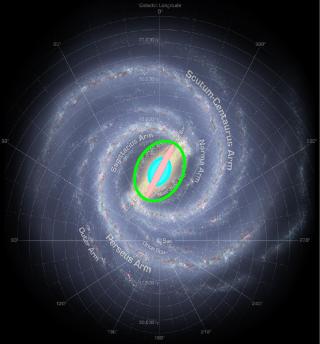
Milky Way and Nearby Galaxies
The overall aim of the project is to study the morphology, stellar populations, kinematics and dynamics (including formation and evolution) of the Milky Way and its satellite galaxies and other Local Group galaxies. The project can be divided into two main lines: I. Structure of the Milky Way and nearby galaxies. The detailed study of the
Martín
López Corredoira