
Bibcode
Tayar, Jamie; Moyano, Facundo D.; Soares-Furtado, Melinda; Escorza, Ana; Joyce, Meridith; Martell, Sarah L.; García, Rafael A.; Breton, Sylvain N.; Mathis, Stéphane; Mathur, Savita; Delsanti, Vincent; Kiefer, Sven; Reffert, Sabine; Bowman, Dominic M.; Van Reeth, Timothy; Shetye, Shreeya; Gehan, Charlotte; Grunblatt, Samuel K.
Referencia bibliográfica
The Astrophysical Journal
Fecha de publicación:
11
2022
Revista
Número de citas
17
Número de citas referidas
16
Descripción
In this paper, we report the potential detection of a nonmonotonic radial rotation profile in a low-mass lower-luminosity giant star. For most low- and intermediate-mass stars, the rotation on the main sequence seems to be close to rigid. As these stars evolve into giants, the core contracts and the envelope expands, which should suggest a radial rotation profile with a fast core and a slower envelope and surface. KIC 9267654, however, seems to show a surface rotation rate that is faster than its bulk envelope rotation rate, in conflict with this simple angular momentum conservation argument. We improve the spectroscopic surface constraint, show that the pulsation frequencies are consistent with the previously published core and envelope rotation rates, and demonstrate that the star does not show strong chemical peculiarities. We discuss the evidence against any tidally interacting stellar companion. Finally, we discuss the possible origin of this unusual rotation profile, including the potential ingestion of a giant planet or unusual angular momentum transport by tidal inertial waves triggered by a close substellar companion, and encourage further observational and theoretical efforts.
Proyectos relacionados
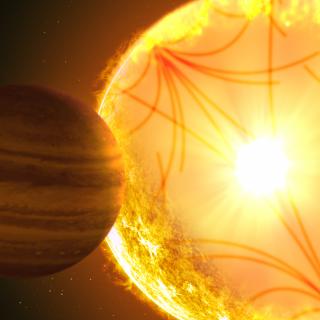
Sismología Solar y Estelar y Búsqueda de Exoplanetas
Los objetivos principales de este proyecto son: 1) estudiar la estructura y la dinámica del interior solar, 2) ampliar este estudio a otros tipos de estrellas y 3) buqueda de planetas extrasolares utilizando métodos fotométricos y su caracterización con información complementaria (espectrometría). Para alcanzar el primer objetivo, utilizamos la
Savita
Mathur