
Bibcode
Raji, Samane; Trujillo, Ignacio; Buitrago, Fernando; Golini, Giulia; Ruiz Cejudo, Ignacio
Referencia bibliográfica
Astronomy and Astrophysics
Fecha de publicación:
12
2025
Revista
Número de citas
1
Número de citas referidas
1
Descripción
Thanks to new advances in astronomical imaging, we can now routinely explore disk galaxy profiles about two magnitudes deeper than the data available 20 years ago. In this regard, it is an opportune time to reevaluate the past classifications of different surface brightness types. In this paper we explore the stellar mass profiles of a sample of disk galaxies with similar stellar masses (∼1010 M⊙) using IAC Stripe82 Legacy Project data. We find that Type I, II-CT, and III-d galaxies exhibit edges at surface brightnesses, μg(Redge), of ∼26.5 mag/arcsec2 and surface mass densities, Σ(Redge), of ∼0.5─1 M⊙/pc2. These surface brightnesses had been outside the range of typical SDSS images and, therefore, unstudied until now. The present data suggest (although the statistics are inconclusive) that the main difference between the previous profile types is the presence of either a more or a less intense bulge. Half of the Type II-CT galaxies are Sc, whereas half of the Type III-d galaxies are Sb. Finally, Type III-d galaxies have low surface mass density disks (Σ(∆Rexp) of ∼0.5 M⊙/pc2) and are bluer ─ (g − r)0= 0.32 ± 0.02 ─ than the other types ((g − r)0= 0.42 ± 0.02 for Types I and II-CT), suggesting that their disks probably formed later in time. ★ We dedicate this work to the memory of Peter Erwin, a pioneer in the classification of disk galaxy types, who unfortunately left us too soon.
Proyectos relacionados
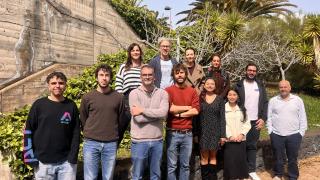
Huellas de la Formación de las Galaxias: Poblaciones estelares, Dinámica y Morfología
Bienvenida a la página web del g rupo de investigación Traces of Galaxy Formation. Somos un grupo de investigación amplio, diverso y muy activo cuyo objetivo principal es entender la formación de galaxias en el Universo de una manera lo más completa posible. Con el estudio detellado de las poblaciones estelares como bandera, estamos constantemente
Anna
Ferré Mateu