Vía Láctea y galaxias cercanas

Año de inicio
1994
Unidad organizativa
    General
    Descripción

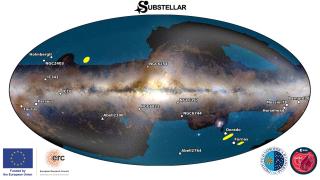
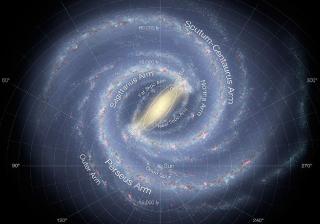
    El objetivo general del proyecto es el estudio de la morfología, poblaciones estelares, cinemática y dinámica (incluyendo formación y evolución) de la Vía Láctea y sus galaxias satélites u otras del Grupo Local. El proyecto puede dividirse en dos líneas principales:
     

    I. Estructura de la Vía Láctea y galaxias cercanas.
    El estudio detallado de la morfología pretende proveer una base de datos de distribución estelar en las regiones más alejadas y extintas de nuestra Galaxia o en otras galaxias. Se hace uso de la combinación de datos propios con los catálogos públicos fotométricos (UKIDSS, VISTA-VVV en infrarrojo cercano o SDSS) o espectroscópicos (SDSS-APOGEE en infrarrojo cercano, LAMOST). El grupo de investigación se ha integrado también en el nodo español de "Gaia" con la idea de orientar parte de nuestro trabajo en el aprovechamiento científico de los datos fotométricos y astrométricos del cartografiado más importante para estudios de la Galaxia: la misión Gaia. Se cuenta con información detallada de la distribución estelar de las poblaciones dominantes en una amplia zona de cielo, abarcando diferentes componentes estructurales en la Vía Láctea: bulbo triaxial, barra larga, disco, brazos espirales, halo. Las componentes de gas y polvo son también objeto de estudio en infrarrojo, o en microondas (estudios de contaminación Galáctica al fondo cósmico de microondas, por ejemplo con datos de Planck).


    II. Estudios dinámicos y de formación y evolución de componentes galácticos.
    Los análisis cinemáticos y dinámicos pretenden hacernos entender el origen de las estructuras observadas y su evolución temporal. Los mapas de velocidades de la Vía Láctea (obtenidos con datos de Gaia y complementados con datos espectroscópicos que permiten una mejor determinación de velocidades radiales, o para separar poblaciones con distintas edades o metalicidades) pueden ajustarse con distintos escenarios teóricos para determinar si la Vía Láctea está en equilibrio o no, el origen de su alabeo, etc.


    Investigador principal
    Personal del proyecto

    Publicaciones relacionadas

    Mostrando 121 - 160 de 191
    Evidence for Blue Straggler Stars Rejuvenating the Integrated Spectra of Globular Clusters 2008ApJ...689L..29C
    Young Stellar Populations and Star Clusters in NGC 1705 2009AJ....138..169A
    The star formation history and dust content in the far outer disc of M31 2012MNRAS.420.2625B
    The magnitude difference between the main sequence turn off and the red giant branch bump in Galactic globular clusters 2011A&A...527A..59C
    The Carina Project. V. The Impact of NLTE Effects on the Iron Content 2012PASP..124..519F
    The Carina Project. IV. Radial Velocity Distribution 2011PASP..123..384F
    Strömgren Photometry of Galactic Globular Clusters. II. Metallicity Distribution of Red Giants in ω Centauri 2009ApJ...706.1277C
    On the ΔV bump HB Parameter in Globular Clusters 2010ApJ...712..527D
    On the White Dwarf Cooling Sequence of the Globular Cluster ω Centauri 2008ApJ...673L..29C
    On the Stellar Content of the Starburst Galaxy IC10 2009ApJ...699L..84S
    On the Stellar Content of the Carina Dwarf Spheroidal Galaxy 2010PASP..122..651B
    On the Relative Distances of ω Centauri and 47 Tucanae 2008ApJ...686L..87B
    On the Radial Extent of the Dwarf Irregular Galaxy IC10 2010ApJ...722L.244S
    On the Radial Distribution of Horizontal Branch Stars in NGC 2808 2009ApJ...696L.120I
    On the Distance and Reddening of the Starburst Galaxy IC 10 2008ApJ...688L..69S
    On the Absolute Age of the Globular Cluster M92 2010PASP..122..991D
    On a New Parameter to Estimate the Helium Content in Old Stellar Systems 2011PASP..123..879T
    On a New Near-Infrared Method to Estimate the Absolute Ages of Star Clusters: NGC 3201 as a First Test Case 2010ApJ...708L..74B
    Constraints on the formation of the globular cluster IC 4499 from multiwavelength photometry 2011MNRAS.415..643W
    The VLT/VISIR mid-IR view of 47 Tucanae. A further step in solving the puzzle of RGB mass loss 2012A&A...537A...2M
    The two metallicity groups of the globular cluster M 22: a chemical perspective 2011A&A...532A...8M
    The Oxygen versus Sodium (Anti)Correlation(S) in ω Cen 2011ApJ...736....5D
    The Infrared Eye of the Wide-Field Camera 3 on the Hubble Space Telescope Reveals Multiple Main Sequences of Very Low Mass Stars in NGC 2808 2012ApJ...754L..34M
    The double sub-giant branch of NGC 6656 (M 22): a chemical characterization 2012A&A...541A..15M
    The C+N+O Abundance of ω Centauri Giant Stars: Implications for the Chemical-enrichment Scenario and the Relative Ages of Different Stellar Populations 2012ApJ...746...14M
    The Acs Survey of Globular Clusters. V. Generating a Comprehensive Star Catalog for each Cluster 2008AJ....135.2055A
    The ACS survey of Galactic globular clusters. XII. Photometric binaries along the main sequence 2012A&A...540A..16M
    The ACS Survey of Galactic Globular Clusters. XI. The Three-dimensional Orientation of the Sagittarius Dwarf Spheroidal Galaxy and Its Globular Clusters 2011ApJ...743...20S
    The ACS Survey of Galactic Globular Clusters. VIII. Effects of Environment on Globular Cluster Global Mass Functions 2010AJ....139..476P
    The ACS Survey of Galactic Globular Clusters. VII. Relative Ages 2009ApJ...694.1498M
    The ACS Survey of Galactic Globular Clusters. VI. NGC 6366: A Heavily Stripped Galactic Globular Cluster 2009AJ....137..246P
    The ACS Survey of Galactic Globular Clusters. IX. Horizontal Branch Morphology and the Second Parameter Phenomenon 2010ApJ...708..698D
    The ACS Survey of Galactic Globular Clusters. III. The Double Subgiant Branch of NGC 1851 2008ApJ...673..241M
    Sodium-Oxygen Anticorrelation and Neutron-capture Elements in Omega Centauri Stellar Populations 2011ApJ...731...64M
    NGC 2419: a large and extreme second generation in a currently undisturbed cluster 2011MNRAS.414.3381D
    Multiple Stellar Populations in 47 Tucanae 2012ApJ...744...58M
    Luminosity and mass functions of the three main sequences of the globular cluster NGC 2808 2012A&A...537A..77M
    Hubble Space Telescope Observations of an Outer Field in Omega Centauri: A Definitive Helium Abundance 2012AJ....144....5K
    Age and helium content of the open cluster NGC 6791 from multiple eclipsing binary members. II. Age dependencies and new insights 2012A&A...543A.106B
    A new visual - near-infrared diagnostic to estimate the metallicity of cluster and field dwarf stars 2012A&A...544A.152C