Cosmología con Trazadores de la Estructura a Gran Escala del Universo

Año de inicio
2012
Unidad organizativa

Subvenciones relacionadas:

    General
    Descripción

    El Fondo Cósmico de Microondas (FCM) contiene la información estadística de las semillas primigenias que han dado lugar a la formación de todas las estructuras en el Universo. Su contrapartida natural en el Universo local es la distribución de las galaxias que surgen como resultado del crecimiento gravitatorio de aquellas fluctuaciones de densidad primigenias. La caracterización de la distribución de inhomogeneidades a gran escala en el Universo local proporciona una herramienta muy poderosa, y complementaria al FCM, para determinar el origen y el contenido energético del Universo, el ritmo de expansión del mismo durante la evolución cósmica, los detalles del proceso de formación de todas las estructuras a gran escala que observamos en el Universo hoy día. Esta es la página web del grupo de Cosmología con trazadores de la Estructura a Gran Escala (LSS de sus siglas en inglés), en el IAC.

    Investigador principal
    Personal del proyecto
    1. eBOSS: análisis cosmológico de los datos de cuásares. Marcos Pellejero Ibañez and F. S. Kitaura participaron en la construcción de la likelihood y en el análisis de los parámetros cosmológicos (including as coauthors Kitaura & Pellejero Ibañez: 2018MNRAS.473.4773A).
    2. EUCLID: proyecto comparativo de códigos para generar catálogos de galaxias sintéticos, donde se demostró la precisión y eficiencia de PATCHY (including as coauthors Balaguera-Antolínez, Kitaura & Pellejero Ibañez: https://arxiv.org/abs/1806.09497, https://arxiv.org/abs/1806.09477, https://arxiv.org/abs/1806.09499)
    3. Desarrollo de un método para asignar el bias para estudios de estructura a gran escala (Balaguera-Antolínez, Kitaura, Pellejero Ibañez et al 2018: https://arxiv.org/abs/1806.05870)
    4. Presentación del proyecto UNITSIM para proporcionar modelos teóricos para comparar con observaciones DESI y EUCLID (including as coauthors Kitaura & Pellejero Ibañez:http://www.unitsims.org/ https://arxiv.org/abs/1811.02111)
    5. Presentación del código BARCODE (Bos, Kitaura & Weygaert 2018: https://arxiv.org/abs/1810.05189, http://adsabs.harvard.edu/abs/2018ascl.soft10002B)

    Publicaciones relacionadas

    J-PLUS: Toward a homogeneous photometric calibration using Gaia BP/RP low-resolution spectra 2024A&A...683A..29L
    Characterizing the ELG luminosity functions in the nearby Universe 2024A&A...683A..46F
    Field-level Lyman-α forest modeling in redshift space via augmented nonlocal Fluctuating Gunn-Peterson Approximation 2024A&A...682A..21S
    J-PLUS: galaxy-star-quasar classification for DR3 2024MNRAS.527.3347V
    The Hubble tension survey: A statistical analysis of the 2012-2022 measurements 2024MNRAS.527.7692W
    A sample of dust attenuation laws for Dark Energy Survey supernova host galaxies 2023A&A...680A..56D
    Chemical Analysis of the Brightest Star of the Cetus II Ultrafaint Dwarf Galaxy Candidate 2023ApJ...959..141W
    J-PLUS: Photometric Recalibration with the Stellar Color Regression Method and an Improved Gaia XP Synthetic Photometry Method 2023ApJS..269...58X
    3D correlations in the Lyman-α forest from early DESI data 2023JCAP...11..045G
    Beyond the 3rd moment: a practical study of using lensing convergence CDFs for cosmology with DES Y3 2023MNRAS.526.5530A
    Photometry of Outer Solar System Objects from the Dark Energy Survey. I. Photometric Methods, Light-curve Distributions, and Trans-Neptunian Binaries 2023ApJS..269...18B
    The Dark Energy Spectroscopic Instrument: one-dimensional power spectrum from first Ly α forest samples with Fast Fourier Transform 2023MNRAS.526.5118R
    Rates and properties of Type Ia supernovae in galaxy clusters within the dark energy survey 2023MNRAS.526.5292T
    Void BAO measurements on quasars from eBOSS 2023MNRAS.526.2889T
    DES Y3 cosmic shear down to small scales: Constraints on cosmology and baryons 2023A&A...678A.109A
    Revisiting constraints on the photon rest mass with cosmological fast radio bursts 2023JCAP...09..025W
    Synchronous Rotation in the (136199) Eris-Dysnomia System 2023PSJ.....4..115B
    DESI mock challenge. Halo and galaxy catalogues with the bias assignment method 2023A&A...673A.130B
    J-PLUS: characterization of high-velocity stars in the second data release 2023MNRAS.522.3898Q
    The Dark Energy Survey Supernova Program: Corrections on Photometry Due to Wavelength-dependent Atmospheric Effects 2023AJ....165..222L
    Ultracool dwarfs candidates based on 6 yr of the Dark Energy Survey data 2023MNRAS.522.1951D
    Dark Energy Survey Year 3 results: Constraints on extensions to Λ CDM with weak lensing and galaxy clustering 2023PhRvD.107h3504A
    Cosmic void exclusion models and their impact on the distance scale measurements from large-scale structure 2023MNRAS.521.4731V
    J-NEP: 60-band photometry and photometric redshifts for the James Webb Space Telescope North Ecliptic Pole Time-Domain Field 2023A&A...671A..71H
    The miniJPAS survey quasar selection - I. Mock catalogues for classification 2023MNRAS.520.3476Q
    Robust sampling for weak lensing and clustering analyses with the Dark Energy Survey 2023MNRAS.521.1184L
    Characterizing the intracluster light over the redshift range 0.2 < z < 0.8 in the DES-ACT overlap 2023MNRAS.521..478G
    Measurement of the mean central optical depth of galaxy clusters via the pairwise kinematic Sunyaev-Zel'dovich effect with SPT-3G and DES 2023PhRvD.107d2004S
    OzDES Reverberation Mapping Program: Hβ lags from the 6-yr survey 2023MNRAS.520.2009M
    Timing the r-process Enrichment of the Ultra-faint Dwarf Galaxy Reticulum II 2023ApJ...944...43S
    Joint analysis of Dark Energy Survey Year 3 data and CMB lensing from SPT and Planck. I. Construction of CMB lensing maps and modeling choices 2023PhRvD.107b3529O
    Joint analysis of Dark Energy Survey Year 3 data and CMB lensing from SPT and P l a n c k . II. Cross-correlation measurements and cosmological constraints 2023PhRvD.107b3530C
    Joint analysis of Dark Energy Survey Year 3 data and CMB lensing from SPT and Planck. III. Combined cosmological constraints 2023PhRvD.107b3531A
    Core-collapse supernovae in the Dark Energy Survey: luminosity functions and host galaxy demographics 2023MNRAS.520..684G
    Concerning colour: The effect of environment on type Ia supernova colour in the dark energy survey 2023MNRAS.519.3046K
    QUIJOTE scientific results - IV. A northern sky survey in intensity and polarization at 10-20 GHz with the multifrequency instrument 2023MNRAS.519.3383R
    Covariance matrices for variance-suppressed simulations 2023MNRAS.518.3737Z
    STRIDES: automated uniform models for 30 quadruply imaged quasars 2023MNRAS.518.1260S
    Constraining the baryonic feedback with cosmic shear using the DES Year-3 small-scale measurements 2023MNRAS.518.5340C
    Lessons learned from the two largest Galaxy morphological classification catalogues built by convolutional neural networks 2023MNRAS.518.2794C

    Congresos relacionados

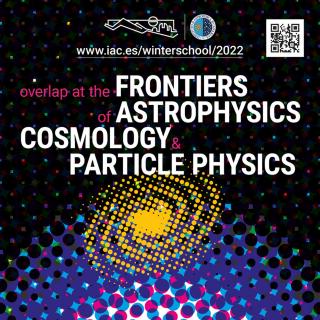
    • Winter School 2022 Poster
      XXXIII Escuela de Invierno de Canarias sobre Astrofísica: Física de Astropartículas y Cosmología
      La XXXIII Canary Islands Winter School of Astrophysics, organizada por el Instituto de Astrofísica de Canarias (IAC), se centra en la Física de Partículas y la Cosmología. La escuela, que se celebrará
      "Salón de actos" del Museo de la Ciencia y el Cosmos (MCC) Avda. Los Menceyes 70 38205 San Cristóbal de La Laguna
      España
      Fecha
      -
      Anteriores