Cosmología con Trazadores de la Estructura a Gran Escala del Universo

Año de inicio
2012
Unidad organizativa

Subvenciones relacionadas:

    General
    Descripción

    El Fondo Cósmico de Microondas (FCM) contiene la información estadística de las semillas primigenias que han dado lugar a la formación de todas las estructuras en el Universo. Su contrapartida natural en el Universo local es la distribución de las galaxias que surgen como resultado del crecimiento gravitatorio de aquellas fluctuaciones de densidad primigenias. La caracterización de la distribución de inhomogeneidades a gran escala en el Universo local proporciona una herramienta muy poderosa, y complementaria al FCM, para determinar el origen y el contenido energético del Universo, el ritmo de expansión del mismo durante la evolución cósmica, los detalles del proceso de formación de todas las estructuras a gran escala que observamos en el Universo hoy día. Esta es la página web del grupo de Cosmología con trazadores de la Estructura a Gran Escala (LSS de sus siglas en inglés), en el IAC.

    Investigador principal
    Personal del proyecto
    1. eBOSS: análisis cosmológico de los datos de cuásares. Marcos Pellejero Ibañez and F. S. Kitaura participaron en la construcción de la likelihood y en el análisis de los parámetros cosmológicos (including as coauthors Kitaura & Pellejero Ibañez: 2018MNRAS.473.4773A).
    2. EUCLID: proyecto comparativo de códigos para generar catálogos de galaxias sintéticos, donde se demostró la precisión y eficiencia de PATCHY (including as coauthors Balaguera-Antolínez, Kitaura & Pellejero Ibañez: https://arxiv.org/abs/1806.09497, https://arxiv.org/abs/1806.09477, https://arxiv.org/abs/1806.09499)
    3. Desarrollo de un método para asignar el bias para estudios de estructura a gran escala (Balaguera-Antolínez, Kitaura, Pellejero Ibañez et al 2018: https://arxiv.org/abs/1806.05870)
    4. Presentación del proyecto UNITSIM para proporcionar modelos teóricos para comparar con observaciones DESI y EUCLID (including as coauthors Kitaura & Pellejero Ibañez:http://www.unitsims.org/ https://arxiv.org/abs/1811.02111)
    5. Presentación del código BARCODE (Bos, Kitaura & Weygaert 2018: https://arxiv.org/abs/1810.05189, http://adsabs.harvard.edu/abs/2018ascl.soft10002B)

    Publicaciones relacionadas

    Fitting of supernovae without dark energy 2022IJMPD..3150104L
    Hubble tensions: a historical statistical analysis 2022MNRAS.517.5805L
    Virial theorem in clusters of galaxies with MOND 2022MNRAS.517.5734L
    Overview of the Instrumentation for the Dark Energy Spectroscopic Instrument 2022AJ....164..207D
    Relativistic angular redshift fluctuations embedded in large scale varying gravitational potentials 2022JCAP...09..038L
    Model selection using baryon acoustic oscillations in the final SDSS-IV release 2022IJMPD..3150065M
    Alternative ideas in cosmology 2022IJMPD..3130014L
    Dark Energy Survey Year 3 results: Imprints of cosmic voids and superclusters in the Planck CMB lensing map 2022MNRAS.515.4417K
    Predicted future fate of COSMOS galaxy protoclusters over 11 Gyr with constrained simulations 2022NatAs...6..857A
    Cosmic void baryon acoustic oscillation measurement: evaluation of sensitivity to selection effects 2022MNRAS.513.5407F
    Missing large-angle correlations versus even-odd point-parity imbalance in the cosmic microwave background 2022A&A...660A.121S
    Evidence for a high-z ISW signal from supervoids in the distribution of eBOSS quasars 2022MNRAS.513...15K
    Black hole virial masses from single-epoch photometry. The miniJPAS test case 2022A&A...660A..95C
    The cosmic web connection to the dark matter halo distribution through gravity 2022MNRAS.512.2245K
    Mapping the Three-dimensional Lyα Forest Large-scale Structure in Real and Redshift Space 2022ApJ...927..230S
    Velocity dispersion and dynamical masses for 388 galaxy clusters and groups. Calibrating the M<SUB>SZ</SUB> − M<SUB>dyn</SUB> scaling relation for the PSZ2 sample 2022A&A...659A.126A
    The completed SDSS-IV extended Baryon Oscillation Spectroscopic Survey: cosmological implications from multitracer BAO analysis with galaxies and voids 2022MNRAS.511.5492Z
    UNITSIM-Galaxies: data release and clustering of emission-line galaxies 2022MNRAS.510.5392K
    Euclid preparation. XV. Forecasting cosmological constraints for the Euclid and CMB joint analysis 2022A&A...657A..91E
    The DES view of the Eridanus supervoid and the CMB cold spot 2022MNRAS.510..216K
    Velocity dispersion and dynamical mass for 270 galaxy clusters in the Planck PSZ1 catalogue 2021A&A...655A.115F
    Euclid preparation. XII. Optimizing the photometric sample of the Euclid survey for galaxy clustering and galaxy-galaxy lensing analyses 2021A&A...655A..44E
    The Bias from Hydrodynamic Simulations: Mapping Baryon Physics onto Dark Matter Fields 2021ApJ...921...66S
    The miniJPAS survey: Photometric redshift catalogue 2021A&A...654A.101H
    J-PLUS: Systematic impact of metallicity on photometric calibration with the stellar locus 2021A&A...654A..61L
    The miniJPAS survey: A preview of the Universe in 56 colors 2021A&A...653A..31B
    Euclid Preparation. XIV. The Complete Calibration of the Color-Redshift Relation (C3R2) Survey: Data Release 3 2021ApJS..256....9S
    Relation of internal attenuation, dust emission, and the size of spiral galaxies. Calibration at low-z and how to use it as a cosmological test at high-z 2021A&A...652A..83L
    Dark Energy Survey Year 3 results: Curved-sky weak lensing mass map reconstruction 2021MNRAS.505.4626J
    The Cluster HEritage project with XMM-Newton: Mass Assembly and Thermodynamics at the Endpoint of structure formation. I. Programme overview 2021A&A...650A.104C
    Cosmological parameter forecasts by a joint 2D tomographic approach to CMB and galaxy clustering 2021PhRvD.103j3502B
    Simultaneous modelling of matter power spectrum and bispectrum in the presence of baryons 2021MNRAS.503.3596A
    Density weighted angular redshift fluctuations: a new cosmological observable 2021MNRAS.503L..56H
    Euclid preparation. XI. Mean redshift determination from galaxy redshift probabilities for cosmic shear tomography 2021A&A...647A.117E
    Exact Semianalytical Calculation of Rotation Curves with Bekenstein-Milgrom Nonrelativistic MOND 2021ApJ...909..137L
    Higher order Hamiltonian Monte Carlo sampling for cosmological large-scale structure analysis 2021MNRAS.502.3976H
    COSMIC BIRTH: efficient Bayesian inference of the evolving cosmic web from galaxy surveys 2021MNRAS.502.3456K
    Cosmology and the massive photon frequency shift in the Standard-Model Extension 2021EPJC...81....4S
    Dark Energy Survey Year 1 results: the lensing imprint of cosmic voids on the cosmic microwave background 2021MNRAS.500..464V
    Constraining primordial non-Gaussianity with postreconstructed galaxy bispectrum in redshift space 2021PhRvD.103b3506S

    Congresos relacionados

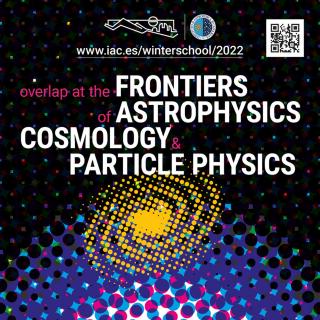
    • Winter School 2022 Poster
      XXXIII Escuela de Invierno de Canarias sobre Astrofísica: Física de Astropartículas y Cosmología
      La XXXIII Canary Islands Winter School of Astrophysics, organizada por el Instituto de Astrofísica de Canarias (IAC), se centra en la Física de Partículas y la Cosmología. La escuela, que se celebrará
      "Salón de actos" del Museo de la Ciencia y el Cosmos (MCC) Avda. Los Menceyes 70 38205 San Cristóbal de La Laguna
      España
      Fecha
      -
      Anteriores